In the previous section we saw details about 30o, 60o and 45o right triangles. In this section, we will see some solved examples based on that discussion.
Solved example 30.13
Calculate the areas of the parallelograms shown in fig.30.16 below
Solution:
Case 1:
1. Let us name the parallelogram as ABCD. Area of parallelogram ABCD = Base × Height
2. But height is not given. So we drop a perpendicular DE from vertex D onto the side AB. This is shown in fig.30.17(a) below:
3. So now we have a right triangle: ⊿AED
4. Consider ⊿AED. For the angle 45o, opposite side is DE. Hypotenuse of the triangle is AD. So we can write:
sin 45 = opposite side⁄hypotenuse = DE⁄AD = DE⁄2
5. But sin 45 = 1⁄√2
6. Equating (4) and (5) we get: DE⁄2 = 1⁄√2 ⟹ DE = 2⁄√2 = (√2×√2)⁄√2 = √2 cm
7. So the required area = Base × Height = 4 × √2 = 4√2 cm2.
Case 2:
1. Let us name the parallelogram as PQRS. Area of parallelogram PQRS = Base × Height
2. But height is not given. So we drop a perpendicular ST from vertex S onto the side PQ. This is shown in fig.30.17(b) above.
3. So now we have a right triangle: ⊿PTS
4. Consider ⊿PTS. For the angle 60o, opposite side is ST. Hypotenuse of the triangle is PS. So we can write:
sin 60 = opposite side⁄hypotenuse = ST⁄PS = ST⁄2
5. But sin 60 = √3⁄2
6. Equating (4) and (5) we get: ST⁄2 = √3⁄2 ⟹ ST = √3 cm
7. So the required area = Base × Height = 4 × √3 = 4√3 cm2.
Solved example 30.14
A rectangular board is to be cut along the diagonal and pieces so formed should be rearranged to form an equilateral triangle. See fig.30.18 below:
Sides of the triangle must be 50 cm. What should be the length and width of the original rectangle in fig(a)?
Solution:
1. Let us name the rectangle as PQRS. See fig.30.19(a) below:
The rectangle is cut along the diagonal PR
2. The ⊿PQR is kept stationary. The other ⊿PSR is shifted and placed in such a way that the top edge SR becomes aligned with PQ. Now we get a triangle.
3. But this triangle must be equilateral. We know that angles in an equilateral triangle are 60o.
4. So, the left right triangle, the angle at P will be 60o.
5. Also, the sides must be 50 cm. So diagonal of the original rectangle must be 50 cm.
6. Blue and red edges must be 25 cm each. That means, width of the original rectangle must be 25 cm
5. From the left side right triangle we get: sin 60 = opposite side⁄hypotenuse
= Green edge⁄50
6. But sin 60 = √3⁄2.
7. Equating (5) and (6) we get: Green edge⁄50 = √3⁄2 ⟹ Green edge = 25√3 cm
8. So the length of the original rectangle must be 25√3 cm and it's width must be 25 cm
Solved example 30.15
Two identical rectangles are cut along the diagonal and the pieces so formed are joined to another rectangle to make a regular hexagon. See fig.30.20 below:
Sides of the regular hexagon must be 30 cm. What should be the length and width of the rectangles?
Solution:
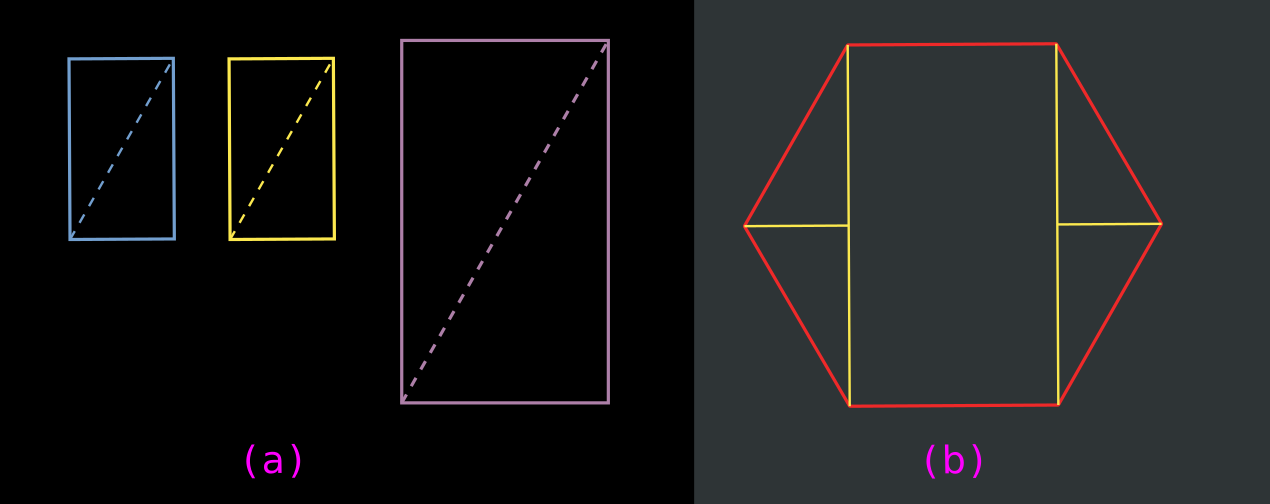
1. The various pieces are shown in fig.30.21(a) below:
2. Fig.30.21(b) shows the method of forming the regular hexagon. It is clear that, the width of the original larger (purple coloured) rectangle must be 30 cm
3. Now we want angles. Sum of interior angles of a regular polygon = (n-2)×180. Where n is the number of sides
• So for a regular hexagon, sum of interior angles = (6-2)×180 = 4×180 = 720
• So angle at each vertex = sum of interior angles⁄number of vertices = 720⁄6 = 120o.
4. Consider the green and blue triangles in fig(c). They are right triangles. Their bases bisect the 120o into 60o and 60o.
5. Consider the green triangle alone. In this triangle, sin 60 = opposite side⁄30
6. But sin 60 = √3⁄2.
7. Equating (5) and (6) we get: opposite side⁄30 = √3⁄2 ⟹ opposite side = 15√3 cm
8. But this opposite side is the length of the original small rectangles. So we get:
• Length of the original small rectangles = 15√3
9. Also, this opposite side is half the length of the original bigger rectangle. So we get:
• Length of the original bigger rectangle = 30√3
10. Again consider the green triangle alone. In this triangle, cos 60 = adjacent side⁄30 =
6. But cos 60 = 1⁄2
7. Equating (5) and (6) we get: adjacent side⁄30 = 1⁄2 ⟹ adjacent side = 15 cm
8. But this adjacent side is the width of the original small rectangles. So we get:
• Width of the original small rectangles = 15 cm
9. Let us write all the required lengths together:
■ Small rectangles:
Length = 15√3 cm
width = 15 cm
■ Large rectangle:
Length = 30√3 cm
Width = 30 cm
Solved example 30.15
Calculate the area of the triangle shown in fig.30.22(a) below:
Solution:
• Let us name the triangle as PQR
1. Area of ΔPQR = 1⁄2 × Base × Altitude
2. But altitude is not given. So we drop a perpendicular RS from vertex R onto the side PQ. This is shown in fig(b)
3. So now we have two right triangles: ⊿PSR and ⊿QSR. Let PS = x cm. Then QS = (4-x) cm
4. Consider ⊿PSR. For the angle 45o, opposite side is RS. Adjacent side is PS. So we can write:
tan 45 = opposite side⁄adjacent side = RS⁄PS = RS⁄x.
5. But tan 45 = 1
6. Equating (4) and (5) we get: RS⁄x = 1 ⟹ RS = x cm
7. Consider ⊿QSR. For the angle 60o, opposite side is RS. Adjacent side is QS. So we can write:
tan 60 = opposite side⁄adjacent side = RS⁄QS = RS⁄(4-X)
8. But tan 60 = √3
9. Equating (7) and (8) we get: RS⁄(4-x) = √3 ⟹ RS = (√3)(4-x) cm
10. Equating (6) and (9) we get: x = (√3)(4-x) ⟹ x = 4√3 - x√3 ⟹ x + x√3 = 4√3
⟹ x(1+√3) = 4√3 ⟹ x = (4√3)⁄(1+√3)
11. So altitude RS = x = (4√3)⁄(1+√3)
12. So the required area = 1⁄2 × Base × Altitude = 1⁄2 × 4 × [(4√3)⁄(1+√3)] = [(8√3)⁄(1+√3)] cm2.
Solved example 30.13
Calculate the areas of the parallelograms shown in fig.30.16 below
 |
| Fig.30.16 |
Case 1:
1. Let us name the parallelogram as ABCD. Area of parallelogram ABCD = Base × Height
2. But height is not given. So we drop a perpendicular DE from vertex D onto the side AB. This is shown in fig.30.17(a) below:
 |
| Fig.30.17 |
4. Consider ⊿AED. For the angle 45o, opposite side is DE. Hypotenuse of the triangle is AD. So we can write:
sin 45 = opposite side⁄hypotenuse = DE⁄AD = DE⁄2
5. But sin 45 = 1⁄√2
6. Equating (4) and (5) we get: DE⁄2 = 1⁄√2 ⟹ DE = 2⁄√2 = (√2×√2)⁄√2 = √2 cm
7. So the required area = Base × Height = 4 × √2 = 4√2 cm2.
Case 2:
1. Let us name the parallelogram as PQRS. Area of parallelogram PQRS = Base × Height
2. But height is not given. So we drop a perpendicular ST from vertex S onto the side PQ. This is shown in fig.30.17(b) above.
3. So now we have a right triangle: ⊿PTS
4. Consider ⊿PTS. For the angle 60o, opposite side is ST. Hypotenuse of the triangle is PS. So we can write:
sin 60 = opposite side⁄hypotenuse = ST⁄PS = ST⁄2
5. But sin 60 = √3⁄2
6. Equating (4) and (5) we get: ST⁄2 = √3⁄2 ⟹ ST = √3 cm
7. So the required area = Base × Height = 4 × √3 = 4√3 cm2.
Solved example 30.14
A rectangular board is to be cut along the diagonal and pieces so formed should be rearranged to form an equilateral triangle. See fig.30.18 below:
 |
| Fig.30.18 |
Solution:
1. Let us name the rectangle as PQRS. See fig.30.19(a) below:
 |
| Fig.30.19 |
2. The ⊿PQR is kept stationary. The other ⊿PSR is shifted and placed in such a way that the top edge SR becomes aligned with PQ. Now we get a triangle.
3. But this triangle must be equilateral. We know that angles in an equilateral triangle are 60o.
4. So, the left right triangle, the angle at P will be 60o.
5. Also, the sides must be 50 cm. So diagonal of the original rectangle must be 50 cm.
6. Blue and red edges must be 25 cm each. That means, width of the original rectangle must be 25 cm
5. From the left side right triangle we get: sin 60 = opposite side⁄hypotenuse
= Green edge⁄50
6. But sin 60 = √3⁄2.
7. Equating (5) and (6) we get: Green edge⁄50 = √3⁄2 ⟹ Green edge = 25√3 cm
8. So the length of the original rectangle must be 25√3 cm and it's width must be 25 cm
Solved example 30.15
Two identical rectangles are cut along the diagonal and the pieces so formed are joined to another rectangle to make a regular hexagon. See fig.30.20 below:
 |
| Fig.30.20 |
Solution:
1. The various pieces are shown in fig.30.21(a) below:
 |
| Fig.30.21 |
3. Now we want angles. Sum of interior angles of a regular polygon = (n-2)×180. Where n is the number of sides
• So for a regular hexagon, sum of interior angles = (6-2)×180 = 4×180 = 720
• So angle at each vertex = sum of interior angles⁄number of vertices = 720⁄6 = 120o.
4. Consider the green and blue triangles in fig(c). They are right triangles. Their bases bisect the 120o into 60o and 60o.
5. Consider the green triangle alone. In this triangle, sin 60 = opposite side⁄30
6. But sin 60 = √3⁄2.
7. Equating (5) and (6) we get: opposite side⁄30 = √3⁄2 ⟹ opposite side = 15√3 cm
8. But this opposite side is the length of the original small rectangles. So we get:
• Length of the original small rectangles = 15√3
9. Also, this opposite side is half the length of the original bigger rectangle. So we get:
• Length of the original bigger rectangle = 30√3
10. Again consider the green triangle alone. In this triangle, cos 60 = adjacent side⁄30 =
6. But cos 60 = 1⁄2
7. Equating (5) and (6) we get: adjacent side⁄30 = 1⁄2 ⟹ adjacent side = 15 cm
8. But this adjacent side is the width of the original small rectangles. So we get:
• Width of the original small rectangles = 15 cm
9. Let us write all the required lengths together:
■ Small rectangles:
Length = 15√3 cm
width = 15 cm
■ Large rectangle:
Length = 30√3 cm
Width = 30 cm
Solved example 30.15
Calculate the area of the triangle shown in fig.30.22(a) below:
 |
| Fig.30.22 |
• Let us name the triangle as PQR
1. Area of ΔPQR = 1⁄2 × Base × Altitude
2. But altitude is not given. So we drop a perpendicular RS from vertex R onto the side PQ. This is shown in fig(b)
3. So now we have two right triangles: ⊿PSR and ⊿QSR. Let PS = x cm. Then QS = (4-x) cm
4. Consider ⊿PSR. For the angle 45o, opposite side is RS. Adjacent side is PS. So we can write:
tan 45 = opposite side⁄adjacent side = RS⁄PS = RS⁄x.
5. But tan 45 = 1
6. Equating (4) and (5) we get: RS⁄x = 1 ⟹ RS = x cm
7. Consider ⊿QSR. For the angle 60o, opposite side is RS. Adjacent side is QS. So we can write:
tan 60 = opposite side⁄adjacent side = RS⁄QS = RS⁄(4-X)
8. But tan 60 = √3
9. Equating (7) and (8) we get: RS⁄(4-x) = √3 ⟹ RS = (√3)(4-x) cm
10. Equating (6) and (9) we get: x = (√3)(4-x) ⟹ x = 4√3 - x√3 ⟹ x + x√3 = 4√3
⟹ x(1+√3) = 4√3 ⟹ x = (4√3)⁄(1+√3)
11. So altitude RS = x = (4√3)⁄(1+√3)
12. So the required area = 1⁄2 × Base × Altitude = 1⁄2 × 4 × [(4√3)⁄(1+√3)] = [(8√3)⁄(1+√3)] cm2.
More solved examples on this topic can be seen here.
In the next section we will see how the trigonometric ratios can be applied to circles.


