In the previous section we saw the conditions for a polynomial. In this section we will see a few expression in which we have to apply those conditions in order to decide whether they are polynomials or not.
Solved example 20.3
In a rectangle, the length of the longer side is 1 cm greater than the shorter side. Write the expression for calculating the length of diagonal of all such triangles. Check whether it is a polynomial or not.
Solution:
The given rectangle has length 1 cm greater than the width. We have to find an expression to calculate it's diagonal. Once we find that expression, we will be able to quickly calculate the diagonal of all such rectangles.
Fig.20.5(a) below shows such a rectangle
1. Let width = x cm. Then length = (x+1) cm
2. The diagonal is the hypotenuse of a right triangle with legs x and (x+1) cm
Applying Pythagoras theorem, we get: Diagonal = √[(x+1)2 + x2]
⇒ Diagonal = √[x2+2x+1+x2] = √[2x2+2x+1]
3. Using this expression, we can calculate the diagonal of any rectangle whose length is 1 unit greater than the width.
4. But it is not a polynomial. Because, the relation between the terms is not just addition. Square root is also coming.
Solved example 20.4
In fig.20.5(b), ABC is an isosceles triangle. It is right angled at C. A rectangle of 1 cm width is attached to the base of ΔABC. Write an expression for the total area of the triangle and the rectangle? Check whether it is a polynomial or not.
Solution:
1. ΔABC has two properties:
• It is right angled at C
• It is isosceles
2. In an isosceles triangle, two sides will be equal.
• Since it is also right angled, the two equal sides are the 'legs'. (∵ there can be only one hypotenuse, which is the longest side)
• The side AB opposite the 90o vertex C will be the hypotenuse. So the legs are CA and CB.
• These legs are equal. Let their lengths be 'x'.
■ Knowing the value of x, the ABC can be easily constructed. And then a 1 cm wide rectangle can be attached to it's base. But in this problem, we do not have to make an actual construction. We can derive the expression using a rough sketch.
3. Applying Pythagoras theorem to ⊿ABC we get hypotenuse AB = √[x2+x2] = √[2x2] = x√2
4. We want the area of ⊿ABC
• Area = 1⁄2 × base × height
• Base is the hypotenuse AB.
• Now we want the height. It is the length of the perpendicular CF dropped from C to AB. This is shown in fig.20.6 below:
• Perpendicular CF will split ⊿ABC into two right triangles: ⊿ACF and ⊿BCF
• Consider any one. Let us take ⊿BCF. It's base BF = 1⁄2 × x√2 = (x√2⁄2)
• Applying Pythagoras theorem, we get: CF2 = BC2 - BF2.
• So CF = √[x2 - (x√2⁄2)2] = √[x2 - (2x2⁄4)]
= √[(4x2 - 2x2)⁄4] = √[(2x2)⁄4] = √[x2⁄2] = x⁄√2.
•Area = 1⁄2 × base × height = 1⁄2 × AB × CF = 1⁄2 × x√2 × x⁄√2 = x2⁄2.
5. Now we want the area of the rectangle ADEB
Area = lb = AB × BE = x√2 × 1 = x√2
6. So total area = x2⁄2+ x√2
7. Let us check the conditions for a polynomial:
• There is only addition between terms
• The exponents in all terms are whole numbers
• So it is a polynomial. We can write: a(x) = x2⁄2+ x√2
Solved example 20.5
Area of a rectangle is 25 cm. It's length is x cm. Write an expression for the perimeter of the rectangle. Check whether it is a polynomial or not.
Solution:
So now we know how to decide whether a given algebraic expression is a polynomial or not. We will see a few more of their properties:
■ We have seen that a polynomial will consist of ‘terms’. Consider the term with the largest exponent. This term has a special name. It is called the leading term. The power of the leading term is called the degree of the whole polynomial. Let us see some examples:
• a(x) = x2 + x. In this polynomial, the leading term is x2. The power of this term is 2.
So this polynomial is of degree 2.
• p(x) = 4x+2. In this polynomial, the leading term is 4x. The power of this term is 1.
So this polynomial is of degree 1.
• p(y) = y4+y2-1. In this polynomial, the leading term is y4. The power of this term is 4.
So this polynomial is of degree 4.
Do we see any peculiarity in the above general forms?
Yes. we see the following peculiarity:
First degree polynomial has two terms in it's general form
Second degree polynomial has three terms in it's general form
Third degree polynomial has four terms in it's general form
Will we ever meet a first degree polynomial with more than two terms?
The answer is 'No'. Let us analyse:
■ A first degree polynomial has the general form: ax + b
1. If there are any more terms, they must all belong to either one of the two categories below:
• Terms with exponent 1
• Terms with exponent less than 1
(Note that terms with exponent greater than 1 are not accepted as first degree polynomials)
2. In the above two categories,
• All terms with exponent 1 will combine together to give the general form 'ax'
• All terms with exponent less than 1 will combine together to give the general form 'b'. [∵ 'less than 1' is zero. And x0 is 1. So (b × x0) = (b×1) = b]
3. So the maximum number of terms possible in a first degree polynomial is 2
■ A second degree polynomial has the general form: ax2 + bx + c
1. If there are any more terms, they must all belong to either one of the three categories below:
• Terms with exponent 2
• Terms with exponent 1
• Terms with exponent less than 1
(Note that terms with exponent greater than 2 are not accepted as second degree polynomials)
2. In the above three categories,
• All terms with exponent 2 will combine together to give the general form 'ax2'
• All terms with exponent 1 will combine together to give the general form 'bx'
• All terms with exponent less than 1 will combine together to give the general form 'c'. [∵ 'less than 1' is zero. And x0 is 1. So (c × x0) = (c×1) = c]
3. So the maximum number of terms possible in a second degree polynomial is 3
We can continue like this and write the following:
• The maximum number of terms possible in a first degree polynomial is 2
• The maximum number of terms possible in a second degree polynomial is 3
• The maximum number of terms possible in a third degree polynomial is 4
So on . . .
Solved example 20.3
In a rectangle, the length of the longer side is 1 cm greater than the shorter side. Write the expression for calculating the length of diagonal of all such triangles. Check whether it is a polynomial or not.
Solution:
The given rectangle has length 1 cm greater than the width. We have to find an expression to calculate it's diagonal. Once we find that expression, we will be able to quickly calculate the diagonal of all such rectangles.
Fig.20.5(a) below shows such a rectangle
 |
| Fig.20.5 |
2. The diagonal is the hypotenuse of a right triangle with legs x and (x+1) cm
Applying Pythagoras theorem, we get: Diagonal = √[(x+1)2 + x2]
⇒ Diagonal = √[x2+2x+1+x2] = √[2x2+2x+1]
3. Using this expression, we can calculate the diagonal of any rectangle whose length is 1 unit greater than the width.
4. But it is not a polynomial. Because, the relation between the terms is not just addition. Square root is also coming.
Solved example 20.4
In fig.20.5(b), ABC is an isosceles triangle. It is right angled at C. A rectangle of 1 cm width is attached to the base of ΔABC. Write an expression for the total area of the triangle and the rectangle? Check whether it is a polynomial or not.
Solution:
1. ΔABC has two properties:
• It is right angled at C
• It is isosceles
2. In an isosceles triangle, two sides will be equal.
• Since it is also right angled, the two equal sides are the 'legs'. (∵ there can be only one hypotenuse, which is the longest side)
• The side AB opposite the 90o vertex C will be the hypotenuse. So the legs are CA and CB.
• These legs are equal. Let their lengths be 'x'.
■ Knowing the value of x, the ABC can be easily constructed. And then a 1 cm wide rectangle can be attached to it's base. But in this problem, we do not have to make an actual construction. We can derive the expression using a rough sketch.
3. Applying Pythagoras theorem to ⊿ABC we get hypotenuse AB = √[x2+x2] = √[2x2] = x√2
4. We want the area of ⊿ABC
• Area = 1⁄2 × base × height
• Base is the hypotenuse AB.
• Now we want the height. It is the length of the perpendicular CF dropped from C to AB. This is shown in fig.20.6 below:
 |
| Fig.20.6 |
• Consider any one. Let us take ⊿BCF. It's base BF = 1⁄2 × x√2 = (x√2⁄2)
• Applying Pythagoras theorem, we get: CF2 = BC2 - BF2.
• So CF = √[x2 - (x√2⁄2)2] = √[x2 - (2x2⁄4)]
= √[(4x2 - 2x2)⁄4] = √[(2x2)⁄4] = √[x2⁄2] = x⁄√2.
•Area = 1⁄2 × base × height = 1⁄2 × AB × CF = 1⁄2 × x√2 × x⁄√2 = x2⁄2.
5. Now we want the area of the rectangle ADEB
Area = lb = AB × BE = x√2 × 1 = x√2
6. So total area = x2⁄2
7. Let us check the conditions for a polynomial:
• There is only addition between terms
• The exponents in all terms are whole numbers
• So it is a polynomial. We can write: a(x) = x2⁄2
Solved example 20.5
Area of a rectangle is 25 cm. It's length is x cm. Write an expression for the perimeter of the rectangle. Check whether it is a polynomial or not.
Solution:
1. For perimeter, we need both
length and width. Here, we are given only the length. But, since area
is given, we can write width in terms of length and area. That is.,
width = area / length = 25/x
2. So perimeter = 2(l+b) = 2(x + 25⁄x) = 2x + 50⁄x
This can be written as: 2x +
50x-1. In this expression, the exponent of x is -1. It is not a whole
number. So 2x + 50⁄x is not a polynomial.So now we know how to decide whether a given algebraic expression is a polynomial or not. We will see a few more of their properties:
■ We have seen that a polynomial will consist of ‘terms’. Consider the term with the largest exponent. This term has a special name. It is called the leading term. The power of the leading term is called the degree of the whole polynomial. Let us see some examples:
• a(x) = x2 + x. In this polynomial, the leading term is x2. The power of this term is 2.
So this polynomial is of degree 2.
• p(x) = 4x+2. In this polynomial, the leading term is 4x. The power of this term is 1.
So this polynomial is of degree 1.
• p(y) = y4+y2-1. In this polynomial, the leading term is y4. The power of this term is 4.
So this polynomial is of degree 4.
■ Instead of saying ‘polynomial
of degree 1’, we say: ‘First degree polynomial’
■ Instead of saying ‘polynomial
of degree 2’, we say: ‘Second degree polynomial’
■ Instead of saying ‘polynomial
of degree 3’, we say: ‘Third degree polynomial’
so on . . .
■ Based on the degree, we can
write the general form of all polynomials:
• First degree polynomial: ax +
b
♦ This is also called a linear polynomial
♦ This is also called a linear polynomial
• Second degree polynomial: ax2 +
bx + c
♦ This is also called a quadratic polynomial
♦ This is also called a quadratic polynomial
• Third degree polynomial: ax3 +
bx2 + cx + d
♦ This is also called a cubic polynomial
♦ This is also called a cubic polynomial
so on . . .
Do we see any peculiarity in the above general forms?
Yes. we see the following peculiarity:
First degree polynomial has two terms in it's general form
Second degree polynomial has three terms in it's general form
Third degree polynomial has four terms in it's general form
Will we ever meet a first degree polynomial with more than two terms?
The answer is 'No'. Let us analyse:
■ A first degree polynomial has the general form: ax + b
1. If there are any more terms, they must all belong to either one of the two categories below:
• Terms with exponent 1
• Terms with exponent less than 1
(Note that terms with exponent greater than 1 are not accepted as first degree polynomials)
2. In the above two categories,
• All terms with exponent 1 will combine together to give the general form 'ax'
• All terms with exponent less than 1 will combine together to give the general form 'b'. [∵ 'less than 1' is zero. And x0 is 1. So (b × x0) = (b×1) = b]
3. So the maximum number of terms possible in a first degree polynomial is 2
■ A second degree polynomial has the general form: ax2 + bx + c
1. If there are any more terms, they must all belong to either one of the three categories below:
• Terms with exponent 2
• Terms with exponent 1
• Terms with exponent less than 1
(Note that terms with exponent greater than 2 are not accepted as second degree polynomials)
2. In the above three categories,
• All terms with exponent 2 will combine together to give the general form 'ax2'
• All terms with exponent 1 will combine together to give the general form 'bx'
• All terms with exponent less than 1 will combine together to give the general form 'c'. [∵ 'less than 1' is zero. And x0 is 1. So (c × x0) = (c×1) = c]
3. So the maximum number of terms possible in a second degree polynomial is 3
We can continue like this and write the following:
• The maximum number of terms possible in a first degree polynomial is 2
• The maximum number of terms possible in a second degree polynomial is 3
• The maximum number of terms possible in a third degree polynomial is 4
So on . . .
We will now see a few more
solved examples
Solved example 20.6
Write each of the relations
below in algebra, and see if it gives a polynomial. Give reasons for
your answer.
(i). A 1 m wide path goes all
around a square ground. The relation between the following two:
• Length of the side
of the ground
• The area of the path
(ii). A liquid contains 7 litres of
water and 8 litres of acid. More acid is added to it. The relation
between the following two:
• Amount of acid added
• The change in percentage of acid
in the liquid.
(iii). Two poles of heights 3 m and 4
m are erected upright on the ground. The distance between the poles
is 5 m. A rope is to be stretched from the top of one pole to some
point on the ground, and from there, to the top of the other pole.
The relation between the following two:
• The distance of the point on
the ground from the foot of any pole
• Total length of the rope
Solution:
(i) A rough sketch is shown in the fig.20.7(a) below:
1. Let the side of the square
ground = x m
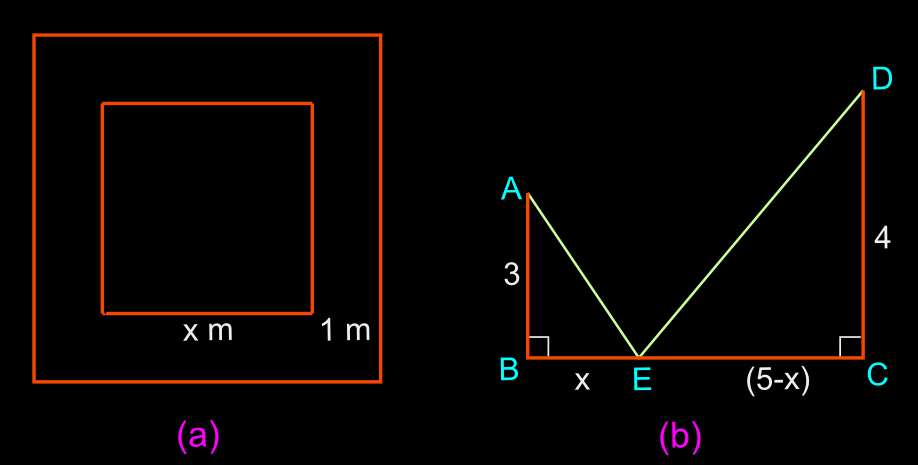 |
| Fig.20.7 |
2. So side of the outer square =
(x+2) m
3. Area of the outer square =
(x+2)2 m2
4. Area of the inner square = x2 m2
5. So area of the path alone =
Area of outer square – Area of inner square
= (x+2)2 - x2
= x2 + 4x + 4 - x2
= 4x+4
6. The above expression gives the relation between the
side of the ground (x), and the area of the path. We can write: a(x) = 2x+4
7. It is a polynomial. Because (Details here):
• It consists of terms which
are added
• Power of all terms are whole
numbers
(ii) 1. Amount of water = 7 litres
• Amount of acid = 8 litres
• Total amount = 7 + 8 = 15
litres
2. Percentage of acid in the
above liquid = (8⁄15) × 100
3. Let the amount of acid newly
added = x litres
• Amount of water after adding
additional acid = 7 litres
• Amount of acid after adding
additional acid = (8+x)
• Total amount after adding
additional acid = 7 + (8+x) = (15+x)
4. Percentage of acid after
adding additional acid = [(8+x)⁄(15+x)]×100
 5. We can write: When x litres of acid is added to a liquid containing 7 litres of water and 8 litres of acid, the 'change in the percentage of acid' is given by = [(7x)⁄15(15+x)]×100
■ Using this expression, we can easily calculate such a 'percentage change'. But the expression is not a polynomial. Because an x term comes in the denominator.
(iii) • A rough sketch is shown in fig.20.7(b). AB and CD are the poles. They are erected upright. So they are perpendicular to the ground BC. The distance BC is 5 m. E is the point on the ground.
• If we take BE as x, CE will be (5-x) m. We have to find the length of the rope which is equal to (AE + ED)
1. ABE and DCE are right triangles. Applying Pythagoras theorem to ⊿ABE, we get:
AE = √[32+x2]
2. Applying Pythagoras theorem to ⊿DCE, we get:
ED = √[(5-x)2+42] = √[25 -10x +x2 +16] = √[41 -10x + x2]
3. So the length of rope = √[32+x2] + √[41 -10x + x2]
4. This is not a polynomial because square root of terms are taken

■ Using this expression, we can easily calculate such a 'percentage change'. But the expression is not a polynomial. Because an x term comes in the denominator.
(iii) • A rough sketch is shown in fig.20.7(b). AB and CD are the poles. They are erected upright. So they are perpendicular to the ground BC. The distance BC is 5 m. E is the point on the ground.
1. ABE and DCE are right triangles. Applying Pythagoras theorem to ⊿ABE, we get:
AE = √[32+x2]
2. Applying Pythagoras theorem to ⊿DCE, we get:
ED = √[(5-x)2+42] = √[25 -10x +x2 +16] = √[41 -10x + x2]
3. So the length of rope = √[32+x2] + √[41 -10x + x2]
4. This is not a polynomial because square root of terms are taken
Solved example 20.7
Write each of the operations
below as an algebraic expression. Find out which are polynomials and
explain why
(i) Sum of a number and it’s
reciprocal
(ii) Sum of a number and it’s
square root
(iii) Product of the following two:
• Sum of a number and it’s
square root
• Difference of a number and
it’s square root
Solution:
(i) 1. Let the number = x. Then it's reciprocal = 1⁄x.
2. Then sum = (x + 1⁄x) = (x + x-1)
3. This is not a polynomial because The power of one term is -1, which is not a whole number.
(ii) 1. Let the number = x. Then it's square root = √x
2. Then sum = (x + √x) = (x + x1/2)
3. This is not a polynomial because The power of one term is 1⁄2, which is not a whole number.
(iii) 1. Let the number = x. Then it's square root = √x
2. Then sum = (x + √x)
3. Difference = (x - √x)
4. Product of the above two: (x + √x)(x - √x) = x2 - x [∵ (a+b)(a-b) = a2 - b2]
5. It is a polynomial. Because (Details here):
• It consists of terms, in which one term is subtracted from the other.
• Power of all terms are whole numbers
Solved example 20.8
Find polynomials p(x)
satifying each of the set of conditions given below:
(i) First degree polynomial with
p(1) = 1 and p(2) = 3
(ii) First degree polynomial with
p(1) = -1 and p(-2) = 3
(iii) Second degree polynomial with
p(0) = 0, p(1) = 2 and p(2) = 6
(iv) Three different second degree
polynomials with p(0) = 0 and p(1) = 2
Solution:
(i) 1. General form of a first degree polynomial is: p(x) = ax + b
2. Given that p(1) = 1. So we get:
p(1) = (a×1) + b = 1 ⇒ a+b = 1
3. Given that p(2) = 3. So we get:
p(2) = (a×2) + b = 3 ⇒ 2a+b = 3
4. From (2) we get: b = (1-a). Substituting this value of a in (3) we get: 2a+(1-a) =3
⇒ a+1 = 3. So we get a = 3-1 = 2
Substituting this value of a in (2) we get: 2+b = 1 ⇒ b = 1-2 = -1
5. So the first degree polynomial p(x) satisfying p(1) = 1 and p(2) = 3 is: p(x) = 2x - 1
(ii) 1. General form of a first degree polynomial is: p(x) = ax + b
2. Given that p(1) = -1. So we get:
p(1) = (a×1) + b = -1 ⇒ a+b = -1
3. Given that p(-2) = 3. So we get:
p(-2) = (a×-2) + b = 3 ⇒ -2a+b = 3
4. From (2) we get: b = (-1-a). Substituting this value of a in (3) we get: -2a+(-1-a) =3
⇒ -1-3a = 3 same as 3a = -4. So we get a = -4⁄3
Substituting this value of a in (2) we get: -4⁄3+b = -1 ⇒ b = -1 + 4⁄3 = 1⁄3
5. So the first degree polynomial p(x) satisfying p(1) = -1 and p(-2) = 3 is: p(x) = (-4⁄3)x + 1⁄3
(iii) 1. General form of a second degree polynomial is: p(x) = ax2 + bx + c
2. Given that p(0) = 0. So we get: p(0) = a×02 + b×0 + c = 0
⇒ 0 + 0 + c = 0 ⇒ c = 0
3. Given that p(1) = 2. So we get:
p(1) = a×12 + b×1 + c = 2 ⇒ a+b+0 = 2 ⇒ a+b = 2
4. Given that p(2) = 6. So we get:
p(2) = a×22 + b×2 + c = 6 ⇒ 4a+2b+0 = 6 ⇒ 2a+b = 3
5. From (3) we get b = (2-a)
Substituting this value of b in (4) we get: 2a+2-a = 3
a+2 = 3 ⇒ a = 1
Substituting this value of a in (3) we get: 1+b =2 ⇒ b = 1
6. So the second degree polynomial p(x) satisfying p(0) =0, p(1) = 2, and p(2) = 6 is:
p(x) = x2 + x
(iv) 1. General form of a second degree polynomial is: p(x) = ax2 + bx + c
2. Given that p(0) = 0. So we get: p(0) = a×02 + b×0 + c = 0
⇒ 0 + 0 + c = 0 ⇒ c = 0
3. Given that p(1) = 2. So we get:
p(1) = a×12 + b×1 + c = 2 ⇒ a+b+0 = 2 ⇒ a+b = 2
4. There are two unknowns 'a' and 'b'. But there is only one equation: a+b =2
5. So it is not possible to find the exact value of either 'a' or 'b'.
But there are many combinations which will satisfy a+b =2
Three possible combinations are:
• a = 1, b = 1.
• a = 1⁄2, b = 3⁄2
• a = 3, b = -1
So three polynomials that satisfy p(0) = 0 and p(1) = 2 are:
• p(x) = x2 + x
• p(x) = (1⁄2)x2 +(3⁄2) x
• p(x) = 3x2 - x
Solved example 20.9
What is the value of b in p(x) = 3x2 - bx +1
Given that p(1) = 2
Solution:
Given that p(1) = 2. So we get: p(1) = 3×12 - b×1 + 1 = 2
⇒ 3 -b +1 = 2 ⇒ 4 -b = 2 ⇒ b = 2
Solution:
(i) 1. General form of a first degree polynomial is: p(x) = ax + b
2. Given that p(1) = 1. So we get:
p(1) = (a×1) + b = 1 ⇒ a+b = 1
3. Given that p(2) = 3. So we get:
p(2) = (a×2) + b = 3 ⇒ 2a+b = 3
4. From (2) we get: b = (1-a). Substituting this value of a in (3) we get: 2a+(1-a) =3
⇒ a+1 = 3. So we get a = 3-1 = 2
Substituting this value of a in (2) we get: 2+b = 1 ⇒ b = 1-2 = -1
5. So the first degree polynomial p(x) satisfying p(1) = 1 and p(2) = 3 is: p(x) = 2x - 1
(ii) 1. General form of a first degree polynomial is: p(x) = ax + b
2. Given that p(1) = -1. So we get:
p(1) = (a×1) + b = -1 ⇒ a+b = -1
3. Given that p(-2) = 3. So we get:
p(-2) = (a×-2) + b = 3 ⇒ -2a+b = 3
4. From (2) we get: b = (-1-a). Substituting this value of a in (3) we get: -2a+(-1-a) =3
⇒ -1-3a = 3 same as 3a = -4. So we get a = -4⁄3
Substituting this value of a in (2) we get: -4⁄3+b = -1 ⇒ b = -1 + 4⁄3 = 1⁄3
5. So the first degree polynomial p(x) satisfying p(1) = -1 and p(-2) = 3 is: p(x) = (-4⁄3)x + 1⁄3
(iii) 1. General form of a second degree polynomial is: p(x) = ax2 + bx + c
2. Given that p(0) = 0. So we get: p(0) = a×02 + b×0 + c = 0
⇒ 0 + 0 + c = 0 ⇒ c = 0
3. Given that p(1) = 2. So we get:
p(1) = a×12 + b×1 + c = 2 ⇒ a+b+0 = 2 ⇒ a+b = 2
4. Given that p(2) = 6. So we get:
p(2) = a×22 + b×2 + c = 6 ⇒ 4a+2b+0 = 6 ⇒ 2a+b = 3
5. From (3) we get b = (2-a)
Substituting this value of b in (4) we get: 2a+2-a = 3
a+2 = 3 ⇒ a = 1
Substituting this value of a in (3) we get: 1+b =2 ⇒ b = 1
6. So the second degree polynomial p(x) satisfying p(0) =0, p(1) = 2, and p(2) = 6 is:
p(x) = x2 + x
(iv) 1. General form of a second degree polynomial is: p(x) = ax2 + bx + c
2. Given that p(0) = 0. So we get: p(0) = a×02 + b×0 + c = 0
⇒ 0 + 0 + c = 0 ⇒ c = 0
3. Given that p(1) = 2. So we get:
p(1) = a×12 + b×1 + c = 2 ⇒ a+b+0 = 2 ⇒ a+b = 2
4. There are two unknowns 'a' and 'b'. But there is only one equation: a+b =2
5. So it is not possible to find the exact value of either 'a' or 'b'.
But there are many combinations which will satisfy a+b =2
Three possible combinations are:
• a = 1, b = 1.
• a = 1⁄2, b = 3⁄2
• a = 3, b = -1
So three polynomials that satisfy p(0) = 0 and p(1) = 2 are:
• p(x) = x2 + x
• p(x) = (1⁄2)x2 +(3⁄2) x
• p(x) = 3x2 - x
Solved example 20.9
What is the value of b in p(x) = 3x2 - bx +1
Given that p(1) = 2
Solution:
Given that p(1) = 2. So we get: p(1) = 3×12 - b×1 + 1 = 2
⇒ 3 -b +1 = 2 ⇒ 4 -b = 2 ⇒ b = 2

