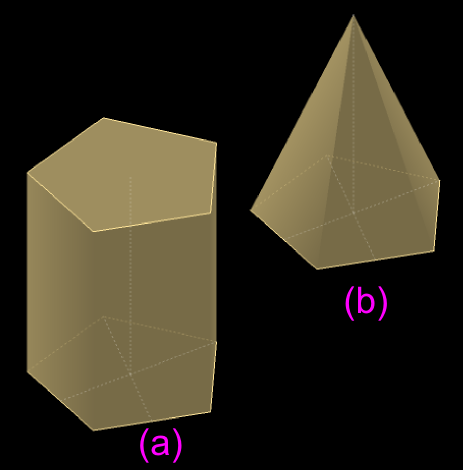
In the previous section we saw the calculation of the surface area of square pyramids. In this section, we will see a few solved examples. Later in this section, we will see how the height of a square pyramid can be used to find it's lateral surface area.
Solved example 33.1
A square of side 5 cm and four isosceles triangles of base 5 cm and height 8 cm are to be put together to make a square pyramid. How many square centimetres of paper is needed?
Solution:
1. Base area = 5 × 5 = 25 cm2
2. Area of one isosceles triangle = 1⁄2 × base × altitude = 1⁄2 × 5 × 8 = 20 cm2
3. Area of four such isosceles triangles = 4 × 20 = 80 cm2
4. Total surface area = 25 + 80 = 105 cm2
Solved example 33.2
A toy is in the shape of a square pyramid of base edge 16 cm and slant height 10 cm. What is the total cost of painting 500 such toys, at Rs 80 per square metre?
Solution:
1. Base area = 16 × 16 = 256 cm2
2. Area of one isosceles triangle = 1⁄2 × base × altitude = 1⁄2 × 16 × 10 = 80 cm2
3. Area of four such isosceles triangles = 4 × 80 = 320 cm2
4. Total surface area = 256 + 320 = 576 cm2
5. Total surface area of 500 toys = 500 × 576 = 288000 cm2 = 28.8 m2
6. Cost of painting 500 toys = 28.8 × 80 = Rs. 2304/-
Solved example 33.3
The lateral faces of a square pyramid are equilateral triangles and the base edge is 30 cm. What is it's surface area?
Solution:
• Given that the lateral faces are equilateral triangles
♦ So the base edge of the pyramid will be equal to the lateral edge.
♦ Thus we get: Lateral edge of the pyramid = 30 cm
• So the lateral faces are equilateral triangles of side 30 cm
♦ Area of an equilateral triangle = (√3×s2)⁄4
♦ Where s is the side of the equilateral triangle (See derivation here)
1. So we get:
Area of one lateral face = (√3×302)⁄4 = 225√3 cm2
2. Area of the four lateral faces = 4 × 225√3 = 900√3 cm2
3. Area of base = 30 × 30 = 900 cm2
Total surface area = 900 + 900√3 = 900(1+√3) cm2
Solved example 33.4
The perimeter of the base of a square pyramid is 40 cm and the total length of all it's edges is 92 cm. Calculate it's surface area.
Solution:
1. Let b be the base edge and l the lateral edge. Then we can write:
4b + 4l = 92 cm
2. But 4b is given as 40 cm. So we get b = 40⁄4 = 10 cm
3. Substituting this value of b in (1) we get: 40 + 4l = 92 ⟹ 4l = 52 ⟹ l = 13 cm
4. Altitude of one isosceles triangle = √[132 - 52] = √[169 - 25] = √[144] = 12 cm
• Now we can calculate the total surface area
5. Base area = 10 × 10 = 100 cm2
6. Area of one isosceles triangle = 1⁄2 × base × altitude = 1⁄2 × 10 × 12 = 60 cm2
7. Area of four such isosceles triangles = 4 × 60 = 240 cm2
8. Total surface area = 100 + 240 = 340 cm2
Solved example 33.5
Can we make a square pyramid with the lateral surface area equal to the base area?
Solution:
1. Consider the base of a square pyramid. Let it be a square of side a. This is shown in fig.33.10(a) below:
2. In the fig.a, P is the apex of the pyramid
• Q and R are the midpoints of two opposite sides of the base
• The diagonals of the base intersect at O
3. Consider the right triangle POQ
• Obviously, the hypotenuse of ⊿POQ is the slant height of the pyramid. Let it be l
4. Now we can calculate the areas:
(a) Base area = a2
(b) Area of one isosceles triangle on the lateral surface = 1⁄2 × base × altitude
= 1⁄2 × a × l = 1⁄2 × (al)
(c) Area of four isosceles triangles = 4 × 1⁄2 × (al) = 2al.
• So total lateral surface area = 2al
5. Let us assume that the two areas are equal. That is:
Base area = Lateral surface area
• Then we can write: a2 = 2al
⟹ a = 2l.
6. So we can write:
• If the lateral surface area of a square pyramid is same as it's base area, then, 'twice the slant height' will have to be equal to the 'base edge'
• Let us see if such a situation is possible:
7. Consider the measurements in fig.b
• The apex P is now brought down to P'. That is., height of the pyramid is now smaller than that in fig.a
• P' is closer to O
• Consequently, l is reduced to l'.
• The length l' is now closer to a⁄2.
• This is same as: 2l' is now closer to a. (∵ QR = a)
8. If we bring down P' even more closer to O, l' will become even more closer to a⁄2
• If we go on lowering the apex, the stage will reach when the apex and O coincides.
• At that stage, twice the slant height will be exactly equal to a
• But such a situation is of no use to us. because, when P and O coincides, we no longer have a pyramid. It is just a plane
9. So it is clear:
• If there is to be a pyramid, P should not coincide with O and then 2l will not be equal to a
So our assumption in (5) is wrong. We can write:
• If there is to be a square pyramid, the base area can never be equal to it's lateral surface area
• For a square pyramid, this height has much significance. If we know the base edge and height of a square pyramid, we can easily make that pyramid.
• No other property of that pyramid is required
Let us see an example:
■ It is decided to make a tent in the shape of a square pyramid. The base must be 6 × 6 m square and the height must be 4 m. How can the tent be erected?
Solution:
1. Mark a square of side 6 m on the ground. This is shown in fig.33.11(a) below.
2. Draw the diagonals. Mark the point of intersection of the two diagonals as O
3. Erect a straight pole of length 4 m at O
4. The top end of the pole is the apex. Join the apex to the four corners of the base square
• With the above four steps, we get the basic frame of the pyramidal tent.
■ So a square pyramid can be completely defined by just two items:
• The base edge
• The height
There are lot of technical specifications for making a tent. We are not concerned about them in our present discussion.
• But we will surely want to know the lateral surface area. Then only we will be able to procure enough canvas sheet to cover the tent.
• Calculation of lateral surface area is easy. We do not have to take actual measurements on the tent frame.
• We can calculate it just by using the base edge and height. Let us write the steps:
1. We have seen that, to calculate the lateral surface area, we need the slant height.
• Consider fig.33.11(b). A red triangle OAB is drawn. It is right angled at O.
• OB is the height of the tent which is 4 m.
• A is the midpoint of a base edge. Clearly, AB is the slant height.
2. But to calculate AB using Pythagoras theorem, we need to know OA first.
• It can be easily seen that, OA is same as CD, the half of base edge
• Base edge = 6 m. So CD = OA = 3 m
• So we can calculate the slant height:
AB = √[42 + 32] = √[16 + 9] = √[25] = 5 m
3. So area of one isosceles triangle = 1⁄2 × base × altitude = 1⁄2 × 6 × 5 = 15 m2
• So area of 4 isosceles triangles = 4 × 15 = 60 m2. This is the lateral surface area.
• But we will have to procure a little more than 60 sq.m. The extra quantity required will be mentioned in the technical specifications
■ The above problem gives us the method to use height for calculating lateral surface area. The trick is to imagine a red triangle OAB inside the pyramid. This is shown in fig.33.11(c)
• It should satisfy the following conditions:
♦ OAB must be right angled
♦ O must coincide with the centre of the base
♦ A must coincide with the midpoint of a base edge
♦ B must coincide with the apex
• If the above conditions are satisfied,
♦ The base OA of ⊿OAB will be half the base edge
♦ The altitude OB will be the height
♦ The hypotenuse AB will be the slant height, which can be easily computed using Pythagoras theorem
Now we will see a solved example
Solved example 33.6
Part (i)
A square pyramid has the following dimensions:
(a) Side of the base is 24 cm
(b) Height of each of the four isosceles triangles is 18 cm
Calculate the height of that pyramid
Part (ii)
A square pyramid has the following dimensions:
(a) Side of the base is 24 cm
(b) The equal sides of each of the four isosceles triangles is 30 cm
Calculate the height of that pyramid
Solution:
Part (i):
1. Imagine the ⊿OAB inside the pyramid.
• It should satisfy the following conditions (see fig.33.12.a):
♦ OAB must be right angled
♦ O must coincide with the centre of the base
♦ A must coincide with the midpoint of a base edge
♦ B must coincide with the apex
• We will get:
♦ OB = height of pyramid
♦ OA = half of base edge = 12 cm
♦ AB = slant height = 18 cm
2. Applying Pythagoras theorem, we get:
OB = √[182 - 122] = √[324 - 144] = √[180] = √[5×4×9] = √5×√4×√9 = 2×3√[5] = 6√5 cm
Part (ii):
1. Imagine ⊿OCB inside the pyramid.
• It should satisfy the following conditions (see fig.33.12.b):
♦ OCB must be right angled
♦ O must coincide with the centre of the base
♦ C must coincide with a corner the base square
♦ B must coincide with the apex
• We will get:
♦ OB = height of pyramid
♦ OC = half of a diagonal of the base
♦ BC = Lateral edge = 30 cm
2. Applying Pythagoras theorem, we get:
OB = √[BC2 - OC2] = √[302 - OC2]
3. Now OC = half of the diagonal
Full diagonal (see fig.33.12.c)= √[242 + 242] = 24√2 cm
So half diagonal = OC = 12√2
4. Substituting this value of OC in (2), we get:
OB = √[302 - (12√2)2] = √[900-(144×2)] = √[612] cm
Solved example 33.7
A square pyramid of base edge 10 cm and height 12 cm is to be made of paper. What should be the dimensions of the triangles?
Solution:
1. All the four triangles must be equal and isosceles
• The base of all the triangles must obviously be 10 cm.
♦ We have to find the dimension of the equal sides
2. Imagine the ⊿OAB inside the pyramid.
• It should satisfy the following conditions (see fig.33.13.a):
♦ OAB must be right angled
♦ O must coincide with the centre of the base
♦ A must coincide with the midpoint of a base edge
♦ B must coincide with the apex
• We will get:
♦ OB = height of pyramid = 12 cm
♦ OA = half of base edge = 5 cm
♦ AB = slant height
3. Applying Pythagoras theorem, we get:
AB = √[OA2 + OB2] = √[52 + 122] = √[25 + 144] = √[169] = 13 cm
4. So we have an isosceles triangle BCD with base CD as 10 cm and height AB as 13 cm (see fig.33.13.b)
• Length of it's equal sides (BC and BD) = √[52 + 132] = √[25 + 169] = √[194] cm
Solved example 33.8
Prove that in any square pyramid, squares of the height, slant height and lateral edge are in arithmetic sequence
Solution:
1. In this problem, we will take the base edge as '2a' So half of base edge = a
Let the height of the pyramid be h
See fig.33.14.a below:
2. Then square of the slant height = l2 = (a2+h2)
3. Square of diagonal = [(2a)2+(2a)2] = [4a2+4a2] = 8a2
Diagonal = √[8a2] = [(2√2)a] see fig.33.14.b
Half of diagonal = (√2)a
Square of 'half of the diagonal' = [(√2)a]2 = 2a2
4. So square of 'lateral edge' = (2a2+h2). See fig.33.14.c
5. Now we can write the sequence:
square of height, square of slant height, square of lateral edge
⟹ h2, (a2+h2), (2a2+h2)
5. Third term - second term = (2a2+h2) - (a2+h2) = a2
• Second term - first term = (a2+h2) - h2 = a2
• So it is an arithmetic sequence with first term h2 and common difference a2
Solved example 33.9
Consider an isosceles triangle of base 30 cm and equal sides 25 cm. A square pyramid is to be made with that triangle. What would be it's height? What if the base edge is 40 cm instead of 30 cm
Solution:
Part (i):
1. The given isosceles triangle has a base of 30 cm. So the base edge of the square pyramid is 30 cm. See fig.33.15(a)
2. The given isosceles triangle has equal sides of 25 cm. So the lateral edge of the square pyramid is 25 cm
3. Half of the base diagonal (see fig.33.15.b) = OC = 1⁄2 × {√[302 + 302]} = 1⁄2 × {√[2×900]} = 1⁄2 × {30 ×√2} = 15√2 cm
4. Now, back in fig.a, h2 = [252 + (15√2)2] = [625 + 450] = 1075
⟹ h = √1075
Part (ii):
1. The given isosceles triangle has a base of 40 cm. So the base edge of the square pyramid is 40 cm. See fig.33.15(c)
2. The given isosceles triangle has equal sides of 25 cm. So the lateral edge of the square pyramid is 25 cm
3. Half of the base diagonal (see fig.33.15.d) = OC = 1⁄2 × {√[402 + 402]} = 1⁄2 × {√[2×1600]} = 1⁄2 × {40 ×√2} = 20√2 cm
4. Now, back in fig.a, h2 = [252 + (20√2)2] = [625 + 800] = 1425
⟹ h = √1425 cm
In the next section, we will see volume of pyramids
Solved example 33.1
A square of side 5 cm and four isosceles triangles of base 5 cm and height 8 cm are to be put together to make a square pyramid. How many square centimetres of paper is needed?
Solution:
1. Base area = 5 × 5 = 25 cm2
2. Area of one isosceles triangle = 1⁄2 × base × altitude = 1⁄2 × 5 × 8 = 20 cm2
3. Area of four such isosceles triangles = 4 × 20 = 80 cm2
4. Total surface area = 25 + 80 = 105 cm2
Solved example 33.2
A toy is in the shape of a square pyramid of base edge 16 cm and slant height 10 cm. What is the total cost of painting 500 such toys, at Rs 80 per square metre?
Solution:
1. Base area = 16 × 16 = 256 cm2
2. Area of one isosceles triangle = 1⁄2 × base × altitude = 1⁄2 × 16 × 10 = 80 cm2
3. Area of four such isosceles triangles = 4 × 80 = 320 cm2
4. Total surface area = 256 + 320 = 576 cm2
5. Total surface area of 500 toys = 500 × 576 = 288000 cm2 = 28.8 m2
6. Cost of painting 500 toys = 28.8 × 80 = Rs. 2304/-
Solved example 33.3
The lateral faces of a square pyramid are equilateral triangles and the base edge is 30 cm. What is it's surface area?
Solution:
• Given that the lateral faces are equilateral triangles
♦ So the base edge of the pyramid will be equal to the lateral edge.
♦ Thus we get: Lateral edge of the pyramid = 30 cm
• So the lateral faces are equilateral triangles of side 30 cm
♦ Area of an equilateral triangle = (√3×s2)⁄4
♦ Where s is the side of the equilateral triangle (See derivation here)
1. So we get:
Area of one lateral face = (√3×302)⁄4 = 225√3 cm2
2. Area of the four lateral faces = 4 × 225√3 = 900√3 cm2
3. Area of base = 30 × 30 = 900 cm2
Total surface area = 900 + 900√3 = 900(1+√3) cm2
Solved example 33.4
The perimeter of the base of a square pyramid is 40 cm and the total length of all it's edges is 92 cm. Calculate it's surface area.
Solution:
1. Let b be the base edge and l the lateral edge. Then we can write:
4b + 4l = 92 cm
2. But 4b is given as 40 cm. So we get b = 40⁄4 = 10 cm
3. Substituting this value of b in (1) we get: 40 + 4l = 92 ⟹ 4l = 52 ⟹ l = 13 cm
4. Altitude of one isosceles triangle = √[132 - 52] = √[169 - 25] = √[144] = 12 cm
• Now we can calculate the total surface area
5. Base area = 10 × 10 = 100 cm2
6. Area of one isosceles triangle = 1⁄2 × base × altitude = 1⁄2 × 10 × 12 = 60 cm2
7. Area of four such isosceles triangles = 4 × 60 = 240 cm2
8. Total surface area = 100 + 240 = 340 cm2
Solved example 33.5
Can we make a square pyramid with the lateral surface area equal to the base area?
Solution:
1. Consider the base of a square pyramid. Let it be a square of side a. This is shown in fig.33.10(a) below:
 |
| Fig.33.10 |
• Q and R are the midpoints of two opposite sides of the base
• The diagonals of the base intersect at O
3. Consider the right triangle POQ
• Obviously, the hypotenuse of ⊿POQ is the slant height of the pyramid. Let it be l
4. Now we can calculate the areas:
(a) Base area = a2
(b) Area of one isosceles triangle on the lateral surface = 1⁄2 × base × altitude
= 1⁄2 × a × l = 1⁄2 × (al)
(c) Area of four isosceles triangles = 4 × 1⁄2 × (al) = 2al.
• So total lateral surface area = 2al
5. Let us assume that the two areas are equal. That is:
Base area = Lateral surface area
• Then we can write: a2 = 2al
⟹ a = 2l.
6. So we can write:
• If the lateral surface area of a square pyramid is same as it's base area, then, 'twice the slant height' will have to be equal to the 'base edge'
• Let us see if such a situation is possible:
7. Consider the measurements in fig.b
• The apex P is now brought down to P'. That is., height of the pyramid is now smaller than that in fig.a
• P' is closer to O
• Consequently, l is reduced to l'.
• The length l' is now closer to a⁄2.
• This is same as: 2l' is now closer to a. (∵ QR = a)
8. If we bring down P' even more closer to O, l' will become even more closer to a⁄2
• If we go on lowering the apex, the stage will reach when the apex and O coincides.
• At that stage, twice the slant height will be exactly equal to a
• But such a situation is of no use to us. because, when P and O coincides, we no longer have a pyramid. It is just a plane
9. So it is clear:
• If there is to be a pyramid, P should not coincide with O and then 2l will not be equal to a
So our assumption in (5) is wrong. We can write:
• If there is to be a square pyramid, the base area can never be equal to it's lateral surface area
How to use the height of a Square pyramid to calculate lateral surface area
We have earlier seen how to determine the height of a pyramid. See fig.33.6 in the previous section.• For a square pyramid, this height has much significance. If we know the base edge and height of a square pyramid, we can easily make that pyramid.
• No other property of that pyramid is required
Let us see an example:
■ It is decided to make a tent in the shape of a square pyramid. The base must be 6 × 6 m square and the height must be 4 m. How can the tent be erected?
Solution:
1. Mark a square of side 6 m on the ground. This is shown in fig.33.11(a) below.
 |
| Fig.33.11 |
3. Erect a straight pole of length 4 m at O
4. The top end of the pole is the apex. Join the apex to the four corners of the base square
• With the above four steps, we get the basic frame of the pyramidal tent.
■ So a square pyramid can be completely defined by just two items:
• The base edge
• The height
There are lot of technical specifications for making a tent. We are not concerned about them in our present discussion.
• But we will surely want to know the lateral surface area. Then only we will be able to procure enough canvas sheet to cover the tent.
• Calculation of lateral surface area is easy. We do not have to take actual measurements on the tent frame.
• We can calculate it just by using the base edge and height. Let us write the steps:
1. We have seen that, to calculate the lateral surface area, we need the slant height.
• Consider fig.33.11(b). A red triangle OAB is drawn. It is right angled at O.
• OB is the height of the tent which is 4 m.
• A is the midpoint of a base edge. Clearly, AB is the slant height.
2. But to calculate AB using Pythagoras theorem, we need to know OA first.
• It can be easily seen that, OA is same as CD, the half of base edge
• Base edge = 6 m. So CD = OA = 3 m
• So we can calculate the slant height:
AB = √[42 + 32] = √[16 + 9] = √[25] = 5 m
3. So area of one isosceles triangle = 1⁄2 × base × altitude = 1⁄2 × 6 × 5 = 15 m2
• So area of 4 isosceles triangles = 4 × 15 = 60 m2. This is the lateral surface area.
• But we will have to procure a little more than 60 sq.m. The extra quantity required will be mentioned in the technical specifications
■ The above problem gives us the method to use height for calculating lateral surface area. The trick is to imagine a red triangle OAB inside the pyramid. This is shown in fig.33.11(c)
• It should satisfy the following conditions:
♦ OAB must be right angled
♦ O must coincide with the centre of the base
♦ A must coincide with the midpoint of a base edge
♦ B must coincide with the apex
• If the above conditions are satisfied,
♦ The base OA of ⊿OAB will be half the base edge
♦ The altitude OB will be the height
♦ The hypotenuse AB will be the slant height, which can be easily computed using Pythagoras theorem
Now we will see a solved example
Solved example 33.6
Part (i)
A square pyramid has the following dimensions:
(a) Side of the base is 24 cm
(b) Height of each of the four isosceles triangles is 18 cm
Calculate the height of that pyramid
Part (ii)
A square pyramid has the following dimensions:
(a) Side of the base is 24 cm
(b) The equal sides of each of the four isosceles triangles is 30 cm
Calculate the height of that pyramid
Solution:
Part (i):
1. Imagine the ⊿OAB inside the pyramid.
• It should satisfy the following conditions (see fig.33.12.a):
♦ OAB must be right angled
♦ O must coincide with the centre of the base
♦ A must coincide with the midpoint of a base edge
♦ B must coincide with the apex
 |
| Fig.33.12 |
♦ OB = height of pyramid
♦ OA = half of base edge = 12 cm
♦ AB = slant height = 18 cm
2. Applying Pythagoras theorem, we get:
OB = √[182 - 122] = √[324 - 144] = √[180] = √[5×4×9] = √5×√4×√9 = 2×3√[5] = 6√5 cm
Part (ii):
1. Imagine ⊿OCB inside the pyramid.
• It should satisfy the following conditions (see fig.33.12.b):
♦ OCB must be right angled
♦ O must coincide with the centre of the base
♦ C must coincide with a corner the base square
♦ B must coincide with the apex
• We will get:
♦ OB = height of pyramid
♦ OC = half of a diagonal of the base
♦ BC = Lateral edge = 30 cm
2. Applying Pythagoras theorem, we get:
OB = √[BC2 - OC2] = √[302 - OC2]
3. Now OC = half of the diagonal
Full diagonal (see fig.33.12.c)= √[242 + 242] = 24√2 cm
So half diagonal = OC = 12√2
4. Substituting this value of OC in (2), we get:
OB = √[302 - (12√2)2] = √[900-(144×2)] = √[612] cm
Solved example 33.7
A square pyramid of base edge 10 cm and height 12 cm is to be made of paper. What should be the dimensions of the triangles?
Solution:
1. All the four triangles must be equal and isosceles
• The base of all the triangles must obviously be 10 cm.
♦ We have to find the dimension of the equal sides
2. Imagine the ⊿OAB inside the pyramid.
• It should satisfy the following conditions (see fig.33.13.a):
♦ OAB must be right angled
♦ O must coincide with the centre of the base
♦ A must coincide with the midpoint of a base edge
♦ B must coincide with the apex
 |
| Fig.33.13 |
♦ OB = height of pyramid = 12 cm
♦ OA = half of base edge = 5 cm
♦ AB = slant height
3. Applying Pythagoras theorem, we get:
AB = √[OA2 + OB2] = √[52 + 122] = √[25 + 144] = √[169] = 13 cm
4. So we have an isosceles triangle BCD with base CD as 10 cm and height AB as 13 cm (see fig.33.13.b)
• Length of it's equal sides (BC and BD) = √[52 + 132] = √[25 + 169] = √[194] cm
Solved example 33.8
Prove that in any square pyramid, squares of the height, slant height and lateral edge are in arithmetic sequence
Solution:
1. In this problem, we will take the base edge as '2a' So half of base edge = a
Let the height of the pyramid be h
See fig.33.14.a below:
 |
| Fig.33.14 |
3. Square of diagonal = [(2a)2+(2a)2] = [4a2+4a2] = 8a2
Diagonal = √[8a2] = [(2√2)a] see fig.33.14.b
Half of diagonal = (√2)a
Square of 'half of the diagonal' = [(√2)a]2 = 2a2
4. So square of 'lateral edge' = (2a2+h2). See fig.33.14.c
5. Now we can write the sequence:
square of height, square of slant height, square of lateral edge
⟹ h2, (a2+h2), (2a2+h2)
5. Third term - second term = (2a2+h2) - (a2+h2) = a2
• Second term - first term = (a2+h2) - h2 = a2
• So it is an arithmetic sequence with first term h2 and common difference a2
Solved example 33.9
Consider an isosceles triangle of base 30 cm and equal sides 25 cm. A square pyramid is to be made with that triangle. What would be it's height? What if the base edge is 40 cm instead of 30 cm
Solution:
Part (i):
1. The given isosceles triangle has a base of 30 cm. So the base edge of the square pyramid is 30 cm. See fig.33.15(a)
 |
| Fig.33.15 |
3. Half of the base diagonal (see fig.33.15.b) = OC = 1⁄2 × {√[302 + 302]} = 1⁄2 × {√[2×900]} = 1⁄2 × {30 ×√2} = 15√2 cm
4. Now, back in fig.a, h2 = [252 + (15√2)2] = [625 + 450] = 1075
⟹ h = √1075
Part (ii):
1. The given isosceles triangle has a base of 40 cm. So the base edge of the square pyramid is 40 cm. See fig.33.15(c)
2. The given isosceles triangle has equal sides of 25 cm. So the lateral edge of the square pyramid is 25 cm
3. Half of the base diagonal (see fig.33.15.d) = OC = 1⁄2 × {√[402 + 402]} = 1⁄2 × {√[2×1600]} = 1⁄2 × {40 ×√2} = 20√2 cm
4. Now, back in fig.a, h2 = [252 + (20√2)2] = [625 + 800] = 1425
⟹ h = √1425 cm