Showing posts with label Inverse proportions. Show all posts

Monday, February 13, 2017

Chapter 24.6 - Inverse Proportions - Part 2

In the previous section we completed the discussion on Direct proportions. In this section we will see Inverse proportions. We have had a discussion about the basics of inverse proportions in chapter 3.8. Here we will continue that discussion.
Fig.24.15 below shows the central angle of various regular polygons.
Fig.24.15
• For a triangle, the central angle is 120o
• For a square, the central angle is 90o
• For a pentagon, the central angle is 72o
■ We can calculate the central angle for any regular polygon. The formula is:
x = 360⁄n. Where x is the central angle and n is the number of sides
• Let us write the results in a tabular form:

• We can see that the product nx is a constant. The value of the constant is 360. So we can write: nx = 360
• When one quantity (n or x) increases, the other quantity decreases. 
• When one quantity decreases, the other quantity increases. 
• It is a case of inverse proportion.
■ There is another way of saying this:
• We have nx = 360. This is same as x = 360⁄n ⇒ x = 360 × 1⁄n
• So the angle x is proportional to the reciprocal of n

Another example:
1. An object is travelling from a point 'O' at a steady speed 's' of 10 m/s. It has to reach a point P which is 100 metres away. The time 't' required for the travel is 100⁄10 = 10 seconds
2. If the speed is 25 m/s, then t is 100⁄25 = 4 seconds. 
3. If the speed is 20 m/s, then t = 100⁄20 = 5 seconds. Let us tabulate the results:

4. We find that st is a constant. So s and t are inversely proportional to each other.

Many laws in physics are stated in terms of proportions. The Newtons Law of Universal Gravitation is an example. Let us see it's details:
• Any two bodies in the universe attract each other
• The force of attraction is directly proportional to 'the product of their masses'
    ♦ So, if m1 and m2 are the masses of the two bodies, The force of attraction F is directly proportional to m1m2
• The force of attraction is inversely proportional to 'the square of the distance between them'
    ♦ So, if r is the distance between the two bodies, F is inversely proportional to r2. That is., F is proportional to the reciprocal of r2
• Combining the above two, we can write: F is proportional to m1m2⁄r2
■ This is written as F = G m1m2⁄r2. Where G is the constant of proportionality.

We will now see some solved examples:
Solved example 24.10
In rectangles of area 1 square metre, as the length of one side changes, so does the length of the other side. Write the relation between the lengths as an algebraic equation. How do we say this in the language of proportions?
Solution:
1. Let the length of the rectangle be 'l' and width be 'b'
2. Then area 'a'of the rectangle = lb
3. Area is given as a constant which is 1 sq.m
4. So we can write lb = 1
This is the algebraic equation which gives the relation between length and width of a rectangle whose area is 1 sq.m
5. Now we see if there is any proportionality between length and width:
• We have lb = 1. So if length or width increases, the other decreases
• Also, if length or width decreases, the other increases
• Their product will remain constant only if this simultaneous increase and decrease take place.
6. We can write: l = 1⁄b ⇒ l = 1 × 1⁄b
• So length is proportional to the reciprocal of the width
• That means, length and width are inversely proportional
7. The constant of proportionality is 1

Solved example 24.11
In triangles of the same area, how do we say the relation between the length of the longest side, and the length of the perpendicular from the opposite vertex? What if we take the length of the shortest side instead?
Solution:
1. We are considering triangles of the same area. That means area is a constant. Let it be 'a'
• Let the length of the longest side be 'b'
• Let the length of the perpendicular from the opposite vertex to this longest side be 'h'
2. Then we have a = 1⁄2 bh
• This is same as bh = 2a
• Here 2a is a constant. So if b or h increases, the other decreases
• Also, if b or h decreases, the other increases 
• Their product will remain constant only if this simultaneous increase and decrease take place.
3. We can write:
b = 2a⁄h ⇒ b = 2a × 1⁄h. So b is inversely proportional to h
4. If we change the shape of the triangle while keeping the area the same, the longest side that we considered may be come the shortest side. Then h should increase proportionately so that the area will remain the same.

Solved example 24.12
A fixed volume of water is to flow into a rectangular water tank. The rate of flow can be changed using different water pipes. Write the relation between the following quantities as an algebraic equation and in terms of proportions.
(i) The rate of flow and the height of water level
(ii) The rate of flow and the time taken to fill the tank
Solution:
1. Let the rate of flow be 'r' m3/s. That means, in 1 second, 'r' m3 of water will enter the tank.
2. Let the base area of the tank be 'a' m2
• Then in the 1st second  , that is., when t = 1, the height of water level will be:
volume⁄Base area  =  r⁄a  [∵ after 1 second, the volume in the tank will be r m3]
• In the 2nd second, that is., when t = 2, the height of water level will be:
volume⁄Base area  =  2r⁄a  [∵ after 2 seconds, the volume in the tank will be 2r m3]
• In the 3rd second, the height will be 3r⁄a 
3. So we can write:
• The height of water after the nth second = h = nr⁄a ⇒ h = n⁄a × r
• n is a constant because we will put a particular value of n. We want the heigth of water at that n
• a is also a constant
• so n⁄a  is a constant. 
4. Thus we have a relation between two quantities:
• height 'h' at the nth second
• rate of flow 'r'
5. We can write: h = kr. This is the algebraic equation. Where K = n⁄a 
6. From the equation, we can see that h is directly proportional to r. 
The constant of proportionality is k = n⁄a 
part (ii):
1. We can use the same equation in (3). That is: h = n⁄a × r 
2. In this case, h is a constant because of the following two reasons:
• A fixed volume of water is flowing into the tank
• When the tank is filled, it will have a particular value of 'h'. 
3. n is the number of seconds required to fill the tank. It will change if the rate r is increased or decreased.
4. So n and r are the variables. Let us bring them to opposite sides of the '=' sign:
• h = n⁄a × r ⇒ r = ah⁄n  ⇒ r = ah × 1⁄n . This is the algebraic equation.
• ah is a constant. Let it be 'k'. We can write: r = k × 1⁄n .
5. So r is proportional to the reciprocal of n. That means n is inversely proportional to r
• If r increases n decreases, indicating a lesser time sufficient to fill up the tank
• If r decreases, n increases, indicating a greater time required to fill up the tank

We have completed the discussion on direct and inverse proportions. In the next section we discuss some topics in Statistics.


PREVIOUS      CONTENTS       NEXT


                        Copyright©2017 High school Maths lessons. blogspot.in - All Rights Reserved

Thursday, March 24, 2016

Chapter 3.11 - Inverse proportions in Angular measurements

In the previous sections we saw a number of cases where two quantities are in inverse proportion. In this section we will see inverse proportions where angular measurements are involved. 

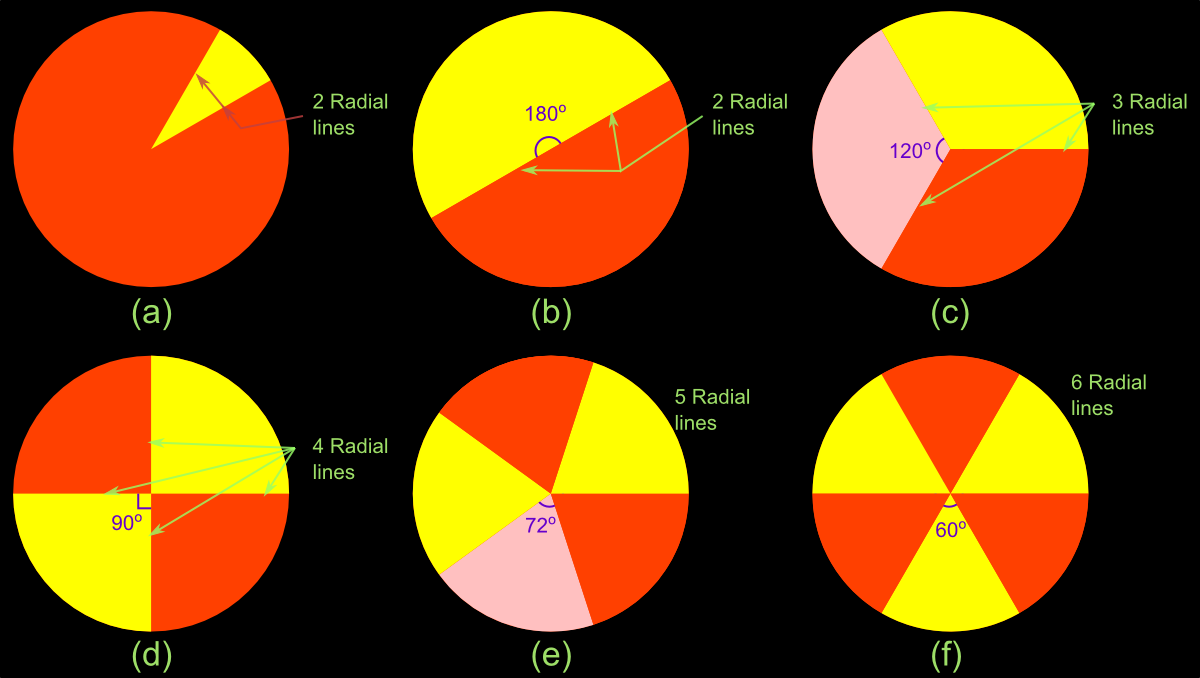
We know that the central angle of a circle is 360o. We can divide the area of a circle into sectors by drawing radial lines. We saw this when we learned about pie charts. In the case of pie charts, the size of each sector will depend upon the value of the quantity that it represents. But on many occasions, we will need to divide a circle into a number of equal sectors. Some examples are: Design of emblems and logos, design of toys, machine parts, etc.,

When two radial lines are drawn, a circle will be divided into 2 sectors. Fig.3.21(a) below shows a circle divided into 2 sectors in this way. In the fig.(a), one sector is small and the other is large.
when the number of sectors increases, the central angle decreases and vice versa
Fig.3.21 Dividing circle into equal sectors

But we want the 2 sectors to be of the same size. For that, we have to draw the two radial lines exactly opposite to each other. This is shown in (b). Now the two sectors are of the same size. As the number of sectors is 2, the central angle of both the sectors is 360/2 = 180o deg.

• When we draw 3 radial lines, we get 3 sectors as shown in the fig.(c). If all the three are of the same size, central angle of each will be equal to 360/3 = 120o.  
• When we draw 4 radial lines, we get 4 sectors as shown in the fig.(d). If all the four are of the same size, central angle of each will be equal to 360/4 = 90o .
• When we draw 5 radial lines, we get 5 sectors as shown in the fig.(e). If all the five are of the same size, central angle of each will be equal to 360/5 = 72o .
• When we draw 6 radial lines, we get 6 sectors as shown in the fig.(f). If all the six are of the same size, central angle of each will be equal to 360/6 = 60o .

- - -
- - -
We can continue like this to draw any number of radial lines, and we can calculate the central angle in each case. We will now form a table of the above results:

From the table we can see that when the number of sectors increase, the central angle decrease and vice versa. Also the product of the two quantities is always equal to 360. Thus it is a case of inverse proportion. 

Using this information, we can divide a circle into any number of equal sectors. For example, if we want a circle to be divided into 9 equal sectors, the table can be formed as:

The number of sectors 9 and the corresponding angle y1 should be given appropriate places in the table. Also 9 and y1 should give the same constant 360. So we can write:
9 × y1 = 360 ⇒ y1 = 360 / 9 = 40o

Another application:
A certain  central angle (say 30o) is given. We have to divide the circle into a number of equal sectors, each having the same 30o as central angle. How many sectors will be there?

The table can be formed as follows:


The angle 30 deg and the corresponding number of sectors x1 should be given appropriate places in the table. Also 30 and x1 should give the same constant 360. So we can write:
30 × x1 = 360 ⇒ x1 = 360 / 30 = 12 sectors.


Graphs of Inverse proportions

We have earlier seen that the graphs of Direct proportions are straight lines. Let us see if we can get such a definite graphical form for inverse proportions. We will plot the values in the table of the second example because it has more coordinates. The table is given here again for easy verification.


The plot will be as follows:
Fig.3.22 Graph of Inverse proportion

We can see that all the points fall in a curved shape. So the graph for an inverse proportion is a curve. We have plotted only a small portion (between x = 1.0 and x = 2.66) of the curve. The full shape of the curve is as shown in fig.3.23 below:
Fig.3.23 Graph of Inverse proportion

From this graph we can note the following points:
• When we move along the x axis towards the right, the x value increases. The corresponding y values decreases because the graph is falling as we move towards the right.
• When we move along the x axis towards the left, the x value decreases. The corresponding y values increases because the graph is rising as we move towards the left.

This is what is expected from an inverse proportion: When x increases, y decreases and vice versa. We will learn about the applications of such graphs in later chapters.

So we have completed the discussion on inverse proportions. In the next chapter we will discuss about integers.

PREVIOUS      CONTENTS       NEXT

                        Copyright©2016 High school Maths lessons. blogspot.in - All Rights Reserved

Tuesday, March 22, 2016

Chapter 3.10 - Inverse proportions - Solved examples

In the previous sections we saw some solved examples on inverse proportions. In this section, we will see a few more.
Solved example 3.21 
A student cycles to school at an average speed of 8 km/hr. He reaches the school in 15 minutes. At what speed should he ride, if he has to reach the school in 10 minutes?
Solution: We will form the table directly from the data. It is shown below:


The distance from home to school remains the same. So if speed increases, the time decreases, and vice versa. Thus it is a case of inverse proportion. 
• The new time 10 minutes and the corresponding new speed x1 should be given appropriate places in the table. 
• Also, x1 and 10 will give the same constant 120. 
So we can write:
10 × x1 = 120 ⇒ x1 = 120 / 10 = 12 km/hr
Solved example 3.22
A work force of 32 men can complete a job in 90 days. 
(i) How many days will it take if the work force is reduced to 24. 
(ii) How many more men should join the present work force, if the job is to be completed in 75 days?
Solution:
The table is given below:

(i) We know that it is a case of inverse proportion because, when the work force increases, time decreases and vice versa. 
• So the new work force 25 and the corresponding new time y1 is given appropriate places in the table as shown above. 
• Also 25 and y1 should give the same constant 2880. 
So we can write:
24 × y1 = 2880 ⇒ y1 = 2880 / 24 = 120 days


(ii) This is an indirect question. They are asking how many 'more'?. But it should not cause any difficulty. We can find the total new number required. This we do by the usual method. Then subtracting the 'old total number of workers' from the 'new total number of workers' will give us the 'more' number of workers.
• The new time 48 days and the corresponding new work force x1 is given appropriate places in the table as shown above. 
• Also 48 and x1 should give the same constant 2880. 
So we can write:
48 × x1 = 2880 ⇒ x1 = 2880 / 48 = 60 workers
So the number of workers needed more = 60 -32 = 28
Solved example 3.23
In a hostel, there are 75 people. The available provisions would last for 35 days. Some people left the hostel on vacation. Now it was found that the provisions would last for 105 days. How many people leave on vacation?
Solution:
This is an indirect question just as in part (ii) of the previous question. We will do it in the usual way to find the final number and then do the subtraction. The table is given below:

• The new time 105 days and the corresponding new no. of people x1 is given appropriate places in the table as shown above. 
• Also 105 and x1 should give the same constant 2625. 
So we can write:
105 × x1 = 2625 ⇒ x1 = 2625 / 105 = 25
So the number of people who left = 75 -25 = 50
Solved example 3.24

Two quantities x and y are inversely proportional to each other. Fill up the missing values in the table given below:

Solution:
• In the table, some columns have x value. They miss the corresponding y value. We have to calculate this missing y value in such columns.
• Some columns have y value. They miss the corresponding x value. We have to calculate this missing x value in such columns.
• We know the equation xy =k. If we have the value of k, and any one of x and y, the other missing value can be calculated (∵ x = k/y and y = k/x). For this method, we have to know the value of k. 
• But k is not given. Or is it?
• k is hidden in the table. If we look at column (vi), we will find that, in it, neither x nor y is missing. We can multiply those values to get k. Thus we get k = 45 × 8 = 360
• Once we have k, we can calculate any missing value. So we proceed as follows:

♦ column (ii):    y = k/x ⇒ y = 360/12 = 30
♦ column (iii):   x = k/y ⇒ x = 360/90 = 4
♦ column (iv):   y = k/x ⇒ y = 360/3 = 120
♦ column (v):    x = k/y ⇒ x = 360/45 = 8
♦ column (vii):  x = k/y ⇒ x = 360/9 = 40


In the next section, we will see inverse variation of angular measurements.

PREVIOUS      CONTENTS       NEXT

                        Copyright©2016 High school Maths lessons. blogspot.in - All Rights Reserved

Chapter 3.9 - Inverse Proportions - Solved examples

In the previous sections we saw the type of variation in which when one quantity increases, the other decreases and vice versa. In this section, we will see some solved examples.

Solved example 3.17
A school has a total fund of ₹ 28000/- to buy chairs. There are 4 types of chairs available in the market: Types A, B, C and D. Their costs are shown in the table below:

Type A B C D
Cost (₹) 300 250 375 224
How many chairs can be purchased if each of the four types are chosen? Form a table showing the variation of two quantities: (1) Cost of one chair (2) No. of chairs that can be purchased. What is the nature of the variation ?
Solution:
• If type A is chosen, the number that can be purchased is 28000 / 300 = 93.33
[Note that 0.33 numbers of chairs cannot be purchased. In such cases, we ignore the decimal part. Only 93 chairs will be purchased. The balance amount will be 0.33 x 300 = ₹ 99.00. This will remain in the school fund. For our discussion purpose, the number can be taken as 93.33] 
• If type B is chosen, the number that can be purchased is 28000 / 250 = 112
• If type C is chosen, the number that can be purchased is 28000 / 375 = 74.67
• If type D is chosen, the number that can be purchased is 28000 / 224 = 125

The table showing the above results is given below:


We can see that, when the cost increases, no. of chairs decreases and vice versa. Also, the product xy is a constant in all the columns.
Solved example 3.18
Duration of a conference meeting is fixed as 4 hours. It is to be divided into equal sessions. The number of sessions should not be less than 3. Also it should not be greater than 7. Show that when the number of sessions increase, the duration of sessions decrease.
Solution:
The total duration of the conference is fixed as 4 hours. It is equal to 4 x 60 = 240 minutes.
Let us divide this available time into equal sessions:
• When the number of sessions is 3, duration of each session = 240/3 = 80 minutes.
• When the number of sessions is 4, duration of each session = 240/4 = 60 minutes.
• When the number of sessions is 5, duration of each session = 240/5 = 48 minutes.
• When the number of sessions is 6, duration of each session = 240/6 = 40 minutes.
• When the number of sessions is 7, duration of each session = 240/7 = 34.3 minutes.


Now we will tabulate the above results. The two quantities are: 1. Number of sessions and, 2. Duration of each session. It is shown below:

We can see that when the number of sessions increase, the duration of sessions decrease and vice versa. Also the product of the two quantities is always a constant.

In all the above examples, 
• When one quantity changes, the other also changes. The change is proportional. 
• But the change is such that, when one quantity increases, the other decreases and vice versa. So it is inverse. 

When two quantities change according to the above rules, they are said to be in Inverse proportion. Also their products xy is always a constant. So such cases will satisfy the equation: xy =k. Where k is a constant.

• When two quantities x and y are in inverse proportion, it is some times written as : x ∝ 1⁄y
• It is read as: x  proportional  to  1⁄y.

In the equation xy = k, left side is a product of two quantities. The right side is a constant. So if one of the quantity increase, the other has to decrease. Then only the right side k will remain as a constant. This property can be effectively used to calculate unknown quantities if two quantities are known to be in inverse proportion. We will see a few such problems below:

Solved example 3.19

A camp has 80 participants. The food provisions in the camp will last for 15 days. 25 more participants join the camp. For how many days will the food provisions last?

Solution:

In this problem, the quantity of food provisions available is a constant. That is., it does not change. The organisers of the camp know that this available provision will last for 15 days if the no. of participants is 80. How do they know it? Let us analyse:

From previous camps, the organisers know that each participant will consume an average provision of ‘u’ on a single day. So the provision consumed by 80 participants on a single day will be 80u. The organisers divide the available provision by 80u. The result they got is 15.

Example:
Let u = 0.75 kg of rice. 
For 80 participants rice required on a single day = 80u = 80 × 0.75 = 60 kg
If the total quantity of rice available is 900 kg, It will last for 900/60 = 15 days. 

In our problem, 25 new participants arrived at the camp. The total no. of participants increase to 105. The new participants will also be consuming u per day. So the total consumption per day increases from 80u to 105u. It is a proportional increase. Obviously, the available provision will not last for 15 days. The no. of days will proportionately decrease. So it is a case of inverse proportion. We are required to find the new number of days. Let us form a table:


• Look at column (iii). 80u is multiplied with 15, to get 1200u, the total available provision. 

• 105u, and the corresponding no. of days (denoted as y1) should be given appropriate places in the same table. And their product is also equal to 1200u. So we can write:

105u × y1 = 1200u ⇒ y1 = 1200u / 105u = 11.43 days (Eleven and a half days approximately). Note that the unknown 'u' cancels out from the numerator and denominator.

The above method involving an analysis with 'u' was shown just to give a basic understanding of the problem. We can solve it directly by using only the given data. The table so formed is given below:

The table is self explanatory. 105 and y1 should give the same constant 1200. So we can write:
105 × y1 = 1200 ⇒ y1 = 1200 / 105 = 11.43 days (same as before).

Note that for direct proportion, the constant was y⁄x. Here, for inverse proportion, the constant is xy
Solved example 3.20
14 workers can do a work in 42 days. How many days will it take if the number of workers is decreased to 12 ?
Solution:
First we will see the table with basic details:

The table is self explanatory.
• ‘u’ is the average work done by a single worker in a single day.
• So 14 workers will do a work of 14u on a single day.
• In 42 days, these 14 workers will do 42 x 14 u = 588u. This is the total work to be completed.
• If the number of workers increase, the number of days will decrease and vice versa. So this is a case of inverse proportion
• If there are 12 workers, the work done 12u by them on a single day, and the corresponding no. of days y1 should also be given appropriate places in the table.
• 12u and y1 will also give the same total work 588u. So we can write:
12u × y1 = 588u ⇒ y1 = 588u / 12u = 49 days

Once we understand the basics, we can write the table directly from the given data:

12 and y1 should give the same constant 588. So we can write:
12 × y1 = 588 ⇒ y1 = 588 / 12 = 49 days (same as before).

In the next section, we will see a few more solved examples.

PREVIOUS      CONTENTS       NEXT

                        Copyright©2016 High school Maths lessons. blogspot.in - All Rights Reserved

Monday, March 21, 2016

Chapter 3.8 - Inverse proportions

In the previous sections we completed the discussion on 'Direct proportions'. In this section we will discuss about 'Inverse proportions'.

Consider the speed of a student when he walks to school. Let it be 3 km per hour. Let us convert this speed to a more basic form: 
• 3 km/hr means he can walk a distance of 3 km in one hour. 
• That means he can walk a distance of 3000 m in 60 minutes. (∵ since 1 km = 1000 m & 1 hr = 60 minutes). 
• So he can walk a distance of 3000/60 = 50 m in 1 minute. So his speed is 50 m / minute. 

Suppose the distance from his home to the school is 400 m. Then the time that he would take can be calculated as follows:
• In the 1st minute he travels 50 m
• In the 2nd minute he travels another 50 m. So the total distance at the end of the 2nd minute is 100m
• In the 3rd minute he travels another 50m. So the total distance at the end of the 3rd minute is 150 m
• In the 4th  minute he travels another 50m. So the total distance at the end of the 4th minute is 200 m
- - -
- - -
• In the 8th minute he travels another 50m. So the total distance at the end of the 8th minute is 400 m

So he takes 8 minutes to travel 400 m from home to school. We do not have to write the 8 steps above. The result, which is '8 minutes' can be obtained simply by dividing the total distance by speed. That is., Time = Distance ÷ speed = 400 m ÷ 50 m / minute = 8 minutes.

For both the methods, the speed must be uniform. That is., he must travel the same 50 m in every minute. If he travels 50 m in one minute and 52 or 45 m in another minute, the speed is not uniform, and our calculations will not work. For our present discussion, whenever we say speed, uniform speed is implied.

So we have calculated the time required for the travel from home to school. Suppose, instead of walking, he rides a cycle. Let the speed of cycle be 80 m/ minute. Then the time required for the travel will be 400/80 = 5 minutes.

Suppose he travels by a car. Let the speed of the car be 200 m/minute. Then the time required for the travel will be 400/200 = 2 minutes.

Let us arrange the above results in a table. It is shown below:

Two quantities are tabulated: 1. Speed (denoted as x) and 2. Time of travel (denoted as y). 
These two quantities vary. 
• When speed increases, time decreases. 
• When speed decreases, time increases. 
That is., When one quantity increases, the other decreases and vice versa. In the lower most row of the table, the product xy of the two quantities are written. We see that it is a constant (equal to 400) in all the columns.

Let us take another example. The example we saw above was the time taken to travel a certain distance. Now we will see the time taken to do a work. Let us dee the details:

A container holds a large number of bricks. The work to be done is the 'unloading all the bricks from the container'. From previous experience, the following information is already known:
• If 4 workers are employed, they will unload all the bricks in 2 days.

With this information, we want to calculate the number of days required when different number of workers are employed. Let us see the calculations:
• Let the ‘average quantity’ of work done by a single worker on a single day be equal to ‘u’.
[Note the use of the word 'average' in the above step. The reason for using it can be explained as follows:
All the workers will not be able to do the same exact quantity of work on a day. Some workers will do more work, and some may do less work. So it is appropriate to take the 'average quantity'. This average is applied to all the workers. That is., it is assumed that all the workers do an average of 'u' on a day]
• So the total work done by 2 workers in 1 day = 2u
• So the total work done by 4 workers in 2 days = 4 x 2u = 8u
• 8u is the total work (unloading all the bricks) to be done. It will not change, and hence is a constant.

Now we want to know the different possibilities:
(1) 2 workers are employed. How many days are required ?
We have:
• Work done by one worker in 1 day = u
• So the work done by 2 workers in 1 day = 2u
• No. of days = Total work / Work done by 2 workers in one day = 8u / 2u = 4 days
(2) 8 workers are employed. How many days are required ?
We have:
• Work done by one worker in 1 day = u
• So the work done by 8 workers in 1 day = 8u
• No. of days = Total work / Work done by 8 workers in one day = 8u / 8u = 1 day
(3) 6 workers are employed. How many days are required ?
We have:
• Work done by one worker in 1 day = u
• So the work done by 6 workers in 1 day = 6u
• No. of days = Total work / Work done by 6 workers in one day = 8u / 6u = 4⁄3 days

4⁄3 days is one day and 1⁄3 days. But 1⁄3 day = (8 × 1⁄3) hours = 8⁄3 = 2 2⁄3 hours (assuming one day = 8 hours of work). So 4⁄3 days = One day plus 2 2⁄3 hours. But for our present discussion, it is sufficient to write 4/3 days.


(4) 5 workers are employed. How many days are required ?
We have:
• Work done by one worker in 1 day = u
• So the work done by 5 workers in 1 day = 5u
• No. of days = Total work / Work done by 5 workers in one day = 8u / 5u = 8⁄5 days
(5) 3 workers are employed. How many days are required ?
We have:
• Work done by one worker in 1 day = u
• So the work done by 3 workers in 1 day = 3u

• No. of days = Total work / Work done by 3 workers in one day = 8u / 3u = 8⁄3 days.  Note that this is double the number of days when 6 workers are employed.

Let us now tabulate the above results. It is shown below:

Two quantities are tabulated: 1. Number of days (denoted as x) 2. Number of workers (denoted as y). These two quantities vary. 
• When No. of workers increases, time decreases.
• When No. of workers decreases, time increases. In such a situation, we say: When one quantity increases, the other decreases and vice versa.

In the lower most row of the table, the product xy of the two quantities are written. We see that it is a constant (equal to 8.00) in all the columns.

In the next section, we will see some solved examples based on the above discussion.

PREVIOUS      CONTENTS       NEXT

                        Copyright©2016 High school Maths lessons. blogspot.in - All Rights Reserved