In the previous sections we saw a number of cases where two quantities are in inverse proportion. In this section we will see inverse proportions where angular measurements are involved.
We know that the central angle of a circle is 360o. We can divide the area of a circle into sectors by drawing radial lines. We saw this when we learned about pie charts. In the case of pie charts, the size of each sector will depend upon the value of the quantity that it represents. But on many occasions, we will need to divide a circle into a number of equal sectors. Some examples are: Design of emblems and logos, design of toys, machine parts, etc.,
When two radial lines are drawn, a circle will be divided into 2 sectors. Fig.3.21(a) below shows a circle divided into 2 sectors in this way. In the fig.(a), one sector is small and the other is large.
But we want the 2 sectors to be of the same size. For that, we have to draw the two radial lines exactly opposite to each other. This is shown in (b). Now the two sectors are of the same size. As the number of sectors is 2, the central angle of both the sectors is 360/2 = 180o deg.
• When we draw 3 radial lines, we get 3 sectors as shown in the fig.(c). If all the three are of the same size, central angle of each will be equal to 360/3 = 120o.
• When we draw 4 radial lines, we get 4 sectors as shown in the fig.(d). If all the four are of the same size, central angle of each will be equal to 360/4 = 90o .
• When we draw 5 radial lines, we get 5 sectors as shown in the fig.(e). If all the five are of the same size, central angle of each will be equal to 360/5 = 72o .
• When we draw 6 radial lines, we get 6 sectors as shown in the fig.(f). If all the six are of the same size, central angle of each will be equal to 360/6 = 60o .
- - -
- - -
We can continue like this to draw any number of radial lines, and we can calculate the central angle in each case. We will now form a table of the above results:

From the table we can see that when the number of sectors increase, the central angle decrease and vice versa. Also the product of the two quantities is always equal to 360. Thus it is a case of inverse proportion.
Using this information, we can divide a circle into any number of equal sectors. For example, if we want a circle to be divided into 9 equal sectors, the table can be formed as:

The number of sectors 9 and the corresponding angle y1 should be given appropriate places in the table. Also 9 and y1 should give the same constant 360. So we can write:
9 × y1 = 360 ⇒ y1 = 360 / 9 = 40o
Another application:
A certain central angle (say 30o) is given. We have to divide the circle into a number of equal sectors, each having the same 30o as central angle. How many sectors will be there?
The table can be formed as follows:

The angle 30 deg and the corresponding number of sectors x1 should be given appropriate places in the table. Also 30 and x1 should give the same constant 360. So we can write:
30 × x1 = 360 ⇒ x1 = 360 / 30 = 12 sectors.

The plot will be as follows:
We can see that all the points fall in a curved shape. So the graph for an inverse proportion is a curve. We have plotted only a small portion (between x = 1.0 and x = 2.66) of the curve. The full shape of the curve is as shown in fig.3.23 below:
From this graph we can note the following points:
• When we move along the x axis towards the right, the x value increases. The corresponding y values decreases because the graph is falling as we move towards the right.
• When we move along the x axis towards the left, the x value decreases. The corresponding y values increases because the graph is rising as we move towards the left.
This is what is expected from an inverse proportion: When x increases, y decreases and vice versa. We will learn about the applications of such graphs in later chapters.
So we have completed the discussion on inverse proportions. In the next chapter we will discuss about integers.
We know that the central angle of a circle is 360o. We can divide the area of a circle into sectors by drawing radial lines. We saw this when we learned about pie charts. In the case of pie charts, the size of each sector will depend upon the value of the quantity that it represents. But on many occasions, we will need to divide a circle into a number of equal sectors. Some examples are: Design of emblems and logos, design of toys, machine parts, etc.,
When two radial lines are drawn, a circle will be divided into 2 sectors. Fig.3.21(a) below shows a circle divided into 2 sectors in this way. In the fig.(a), one sector is small and the other is large.
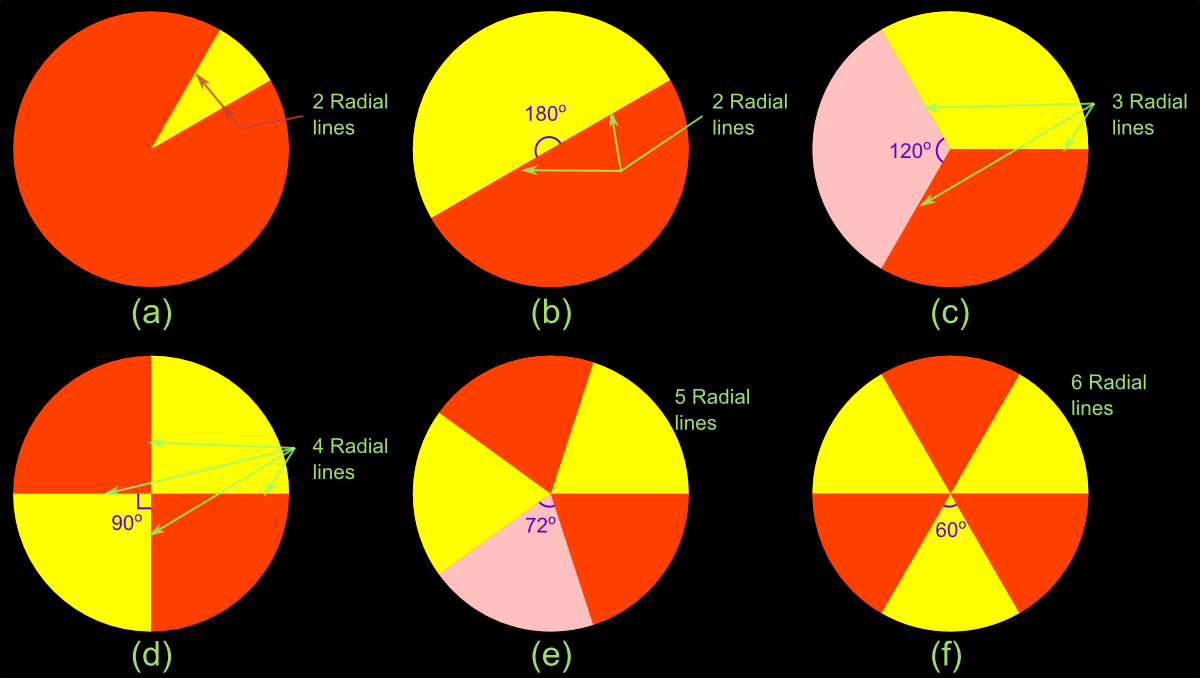 |
| Fig.3.21 Dividing circle into equal sectors |
But we want the 2 sectors to be of the same size. For that, we have to draw the two radial lines exactly opposite to each other. This is shown in (b). Now the two sectors are of the same size. As the number of sectors is 2, the central angle of both the sectors is 360/2 = 180o deg.
• When we draw 3 radial lines, we get 3 sectors as shown in the fig.(c). If all the three are of the same size, central angle of each will be equal to 360/3 = 120o.
• When we draw 4 radial lines, we get 4 sectors as shown in the fig.(d). If all the four are of the same size, central angle of each will be equal to 360/4 = 90o .
• When we draw 5 radial lines, we get 5 sectors as shown in the fig.(e). If all the five are of the same size, central angle of each will be equal to 360/5 = 72o .
• When we draw 6 radial lines, we get 6 sectors as shown in the fig.(f). If all the six are of the same size, central angle of each will be equal to 360/6 = 60o .
- - -
- - -
We can continue like this to draw any number of radial lines, and we can calculate the central angle in each case. We will now form a table of the above results:

From the table we can see that when the number of sectors increase, the central angle decrease and vice versa. Also the product of the two quantities is always equal to 360. Thus it is a case of inverse proportion.
Using this information, we can divide a circle into any number of equal sectors. For example, if we want a circle to be divided into 9 equal sectors, the table can be formed as:

The number of sectors 9 and the corresponding angle y1 should be given appropriate places in the table. Also 9 and y1 should give the same constant 360. So we can write:
9 × y1 = 360 ⇒ y1 = 360 / 9 = 40o
Another application:
A certain central angle (say 30o) is given. We have to divide the circle into a number of equal sectors, each having the same 30o as central angle. How many sectors will be there?
The table can be formed as follows:

The angle 30 deg and the corresponding number of sectors x1 should be given appropriate places in the table. Also 30 and x1 should give the same constant 360. So we can write:
30 × x1 = 360 ⇒ x1 = 360 / 30 = 12 sectors.
Graphs of Inverse proportions
We have earlier seen that the graphs of Direct proportions are straight lines. Let us see if we can get such a definite graphical form for inverse proportions. We will plot the values in the table of the second example because it has more coordinates. The table is given here again for easy verification.
The plot will be as follows:
 |
| Fig.3.22 Graph of Inverse proportion |
We can see that all the points fall in a curved shape. So the graph for an inverse proportion is a curve. We have plotted only a small portion (between x = 1.0 and x = 2.66) of the curve. The full shape of the curve is as shown in fig.3.23 below:
 |
| Fig.3.23 Graph of Inverse proportion |
From this graph we can note the following points:
• When we move along the x axis towards the right, the x value increases. The corresponding y values decreases because the graph is falling as we move towards the right.
• When we move along the x axis towards the left, the x value decreases. The corresponding y values increases because the graph is rising as we move towards the left.
This is what is expected from an inverse proportion: When x increases, y decreases and vice versa. We will learn about the applications of such graphs in later chapters.
So we have completed the discussion on inverse proportions. In the next chapter we will discuss about integers.


