Showing posts with label congruence of triangles. Show all posts

Friday, October 28, 2016

Chapter 18.6 - Triangle division by Medians

In the previous section we saw a new method to find the Circumcentre. In this section, we will see Medians.


We know that, in a triangle, a median is a line drawn from a vertex, to the midpoint of the opposite side. We have seen it before here and here. Let us now draw the three medians of a triangle. 
• Fig.18.32(a) shows a triangle ABC. A median is drawn from vertex C. That is., a line is drawn from the vertex C to the midpoint D of the opposite side BC. 
Fig.18.32

• In fig.b, another median is drawn from the vertex A. 
• And finally, in fig.c, the third median is drawn from vertex B. 
■ Note that, the three medians pass through the same point. We will call this point as ‘G’.

We will now do some calculations with these medians. 
1. Consider any two medians. Let us take those medians from A and B. This is shown in fig.18.33(a) below:
Fig.18.33
2. The ends of the medians are E and F. They are joined by an yellow line.
3. E and F are the midpoints of sides BC and AC. So, by theorem 18.5, EF will be half of AB. That is., EF = AB2
4. Now, there is a smaller triangle ABG inside. Mark the midpoints of it’s sides AG and BG. Let those midpoints be P and Q. This is shown in fig.b
5. Join PQ. Since P and Q are midpoints, by theorem 18.5, PQ will be half of AB. That is., PQ = AB2
6. From (3) and (5), we get PQ = EF
7. We know that PQ is parallel to AB, and EF is also parallel to AB. So PQ and EF are parallel to each other.
8. Thus, in the quadrilateral PQEF shown in fig.18.33(c) below, the opposite sides PQ and EF are equal and parallel. So PQEF is a parallelogram.
Fig.18.33
9. In any parallelogram, the diagonals will bisect each other. So in our parallelogram PQEF, the diagonals PE and FQ will bisect each other. So we can write: • PG = GE  • QG = GF
10. Now let us move back to our original medians AE and BF shown in fig.a. They are now divided at various points P, Q and G. This is shown in fig.d.
11. Consider the median AE. It is divided into three parts AP, PG and GE.
(i) From (4), P is the midpoint of AG. So AP = PG
(ii) From (11.i) and (9), we get: AP = PG = GE. That means, the median AE is divided into three equal parts by points P and G
(iii) On one side of G, there are two equal parts AP and PG, and on the other side, there is one equal part GE.
(iv) So G divides the median AE in the ratio 2:1
The same result of 2:1 ratio can be obtained for the other median BF also. The steps are similar to those from to. But we will write them again:
12. Consider the median BF. It is divided into three parts BQ, QG and GF.
(i) From (4), Q is the midpoint of BG. So BQ = QG
(ii) From (12.i) and (9), we get: BQ = QG = GF. That means, the median BF is divided into three equal parts by points Q and G
(iii) On one side of G, there are two equal parts BQ and QG, and on the other side, there is one equal part GF.
(iv) So G divides the median BF in the ratio 2:1
13. So we find that, G is an important point. It divides the two medians in the ratio 2:1
■ Now, what is this G? Is it very difficult to find the position of G?
Ans: • From fig.18.32(c), G is the point of intersection of the medians of a triangle.
• It is not at all difficult to find the position of G. All we need to do is, to draw any two medians. Their point of intersection is the point ‘G’
14. In fig., we considered a convenient pair of medians. AE and BF. We could take any of the other two possible pairs: • AE and CD  • BF and CD
15. In any case that we take, we will get the same result:
■ The point of intersection of the two medians will divide them both in the ratio 2:1
16. For example, if we take AE and CD, we can write this:
(i) G divides the median AE in the ratio 2:1
(ii) G divides the median CD in the ratio 2:1
From 11, 12  and 16 , we can say that G divides all the three medians in the same ratio 2:1.
We will write it in the form of a theorem:

Theorem 18.6
The point of intersection G divides all the three medians in the ratio 2:1 measured from the vertex

Until now, we have been discussing the 'action of parallel lines' in the interior portion of triangles, and also on the sides of the triangles. Now we will have a short discussion on some thing which happens out side a triangle. Fig.18.34(a) shows a triangle ABC. In the fig.b, the sides AC and BC are extended upwards beyond the vertex C.
Fig.18.34
In the fig.18.34(c) below, a line is drawn parallel to the base AB, cutting through the extended portions. Let it intersect the extensions at P and Q.
Fig.18.34
A red line parallel to AB is drawn through C. This is shown in fig.d. We do not need the portions beyond P and Q. So they are trimmed.
1. Thus, in fig.d, we have three parallel lines:  AB,  'the red line' and  PQ, 
2. Those parallel lines cut through the lines AQ and BP. The distances cut are in the same ratio (Theorem 18.1). So we have: AC:QC = BC:PC  ACQC  = BCPC .
3. Consider a different ratio: PBPC .
PBPC = (PC + BC)PC (∵ PB = PC + BC)
 PBPC = PCPC + BCPC  PBPC = 1 BCPC . 
4. Similarly, consider:  AQCQ .
AQCQ = (CQ + AC)CQ (∵ AQ = CQ + AC)
 AQCQ = CQCQ + ACCQ  AQCQ = 1 ACCQ .
5. Let us rewrite the results in (3) and (4):
From (3) we have: PBPC  = 1 BCPC .
From (4) we have: AQCQ = 1 ACCQ . 
6. The last terms in the above two equations are the same. This we know from (2)
7. So (3) and (4) are equal. That is., PBPC  =  AQCQ . 
■ We can write a summary of the above discussion as follows:
• Extend the sides of a triangle
• Consider one side. Take the ratio: (Extension)(Total length)
• Consider the other side. Take the ratio: (Extension)(Total length)
• Both the ratios will be equal

Now we will see a solved example
Solved example 18.10
In the fig.13.35 below, ABC is a right angled triangle. D is the midpoint of the hypotenuse AC. DE is drawn perpendicular to AB.
Fig.18.35
(i) Prove that DE is half of BC (ii) Prove that, in the larger ABC, the distances from D to all the vertices are equal (iii) Prove that D is the circumcentre of ABC
Solution:
Part (i): 1. DE is parallel to BC. Because, both DE and BC are perpendicular to AB. Also, D is the midpoint of AC. 
2. Theorem 18.4 states: In any triangle, the line drawn parallel to one side, passing through the midpoint of another side, meets the third side also at it's midpoint.
■ So E is the midpoint of AB
3. Now we apply theorem 18.5: The length of a line joining the midpoints of two sides of a triangle is half the length of the third side.
■ So DE is half of BC
Part (ii): The distances to the three vertices are DA, DB and DC. We have to prove that, these three distances are equal.
1. We already know that DA = DC. Because D is the midpoint of AC
Now we will prove that DA = DB. The proof is as follows:
2. In fig.18.35(b) above, consider the triangles: AED and BED
• ED = ED (The common side)
• AE = BE (since E is the midpoint of AB)
• AED and BED are colinear angles, and one of them (AED) ie 90o. So BED = 180 – 90 = 90o
• Thus, AED = BED = 90o
3. Thus we have two sides and included angle same in both the triangles. It is a case of SAS congruence. The two triangles AED and BED are equal.
• Let us write the correspondence:
• ED is the common side. The 90o is at E. So EE and DD
• The remaining vertices are A and B. So AB
• We can write: The correspondence of vertices is: EE, DD and AB
• From the above, we can pick each corner and write the correspondence of sides: EDED, EAEB and DADB
• From the last one DADB, we can write DA= DB
4. From [Part (ii) 1], we have: DA = DC
• From [Part (ii) 3], we have DA = DB
• So we can write DA = DB = DC
5. Thus, the distances from D to all the vertices of ABC are equal
Part (iii): 
• If D is the circumcentre, there exists a circle, with D as it's centre, and with the vertices A, B and C lying on it.
• Indeed there exists such a circle because in part (ii), we proved that A, B and C are at equidistance from D. SO D is the circumcentre of ABC
We can prove this in another way also:
1. Draw the perpendicular bisector of BC as shown in fig.c below
Fig.18.35
2. Let it bisect BC at F. Since, it is a bisector, BF is half of BC
3. Now, using theorem 18.5, DE is also half of BC
4. That means., D and F, are at the same perpendicular distance from the side AB. Also, the perpendicular bisector through F will be parallel to AB
5. So, if we extend the perpendicular bisector, it will pass through D. See fig.d
6. We already know that DE is the perpendicular bisector of AB (since it is perpendicular to AB, and E is the midpoint of AB)
7. So we have the perpendicular bisectors of two sides intersecting at D. Thus D is the circumcentre
An even simpler method:
1. The perpendicular bisector of AB, already passes through D
2. We need one more perpendicular bisector.
3. Why not take the one of the hypotenuse AC. It will pass through D itself.
4. So we get two perpendicular bisectors, and both of them intersect at D. Thus D is the circumcentre

In the next section, we will see more solved examples.


PREVIOUS      CONTENTS       NEXT

                        Copyright©2016 High school Maths lessons. blogspot.in - All Rights Reserved

Friday, May 20, 2016

Chapter 10.5 - RHS Criterion for the Congruence of Triangles

In the previous section we have learned the ASA Criterion for the congruence of Triangles. In this section we will discuss about another criterion.

Fig.10.28(a) below, shows a triangle ABC. Fig.(b) shows five triangles: XYZ, UVY, PQR, DEF, and MNO.
Fig.10.28
Our problem is this: Is there any triangle in fig.(b), which is congruent to ΔABC? If yes, which one?
Solution: Looking at figs.(a) & (b), we find that the measurements of the triangles are incomplete. 
• If the triangles had the lengths of all the 3 sides, then we could straight away use the SSS criterion to check the congruence 
• If two sides and their included angle is given, we could use the SAS criterion
• If two angles and their included side are given, we could use the ASA criterion
But in this situation, these are not possible because the measurements are incomplete. We cannot find an SSS comparison, SAS comparison  or ASA comparison. In such situations, we must try to use other criteria.

We are going to use a rule known as the RHS criterion. First we will see the details about this criterion. Based on that, we will be able to understand how this criterion got it's name.

In the fig.10.28(a), we are given a right angled triangle. In fig.(b), all the triangles that are given for comparison are right angled triangles. Why is that so? 
The answer is that, a 'right angled triangle' will be congruent only with another 'right angled triangle'. There is no point in comparing other triangles.

Now, any given right angled triangle will have one hypotenuse. Any other triangle which is congruent to the given triangle should have the same hypotenuse. This is compulsory for congruence. If the triangle that we are comparing does not have the same hypotenuse, we can straight away discard it from our list.

If it does have the same hypotenuse, it could be a congruent triangle. But we need one more detail. Let us see how this is obtained:
Once we find that the hypotenuse of both the triangles are same, there remains two sides. Those are the ‘legs’. Any one of those legs in the given triangle should have it’s exact replica on the other triangle.

That means, for two right angled triangles to be congruent:
• The hypotenuse must be the same
• Any one leg should be the same
■ There is one more condition: The 90angle. But, as we are comparing only 'right angled triangles', the 90o angle condition will be already satisfied. So we do not have to worry about it.

This RHS criterion gets it’s name thus:
• ‘R’ stands for Right angle
• ‘H’ stands for hypotenuse
• ‘S’ stands for side

Let us apply this rule to our problem:
• Consider fig.10.28(a). We know that, hypotenuse is the side opposite to the 90o angle. 
• So in ΔABC, AB with a length of 8 cm is the hypotenuse. 
• In fig.(b), we find that, ΔMNO is a right angled triangle, and it’s hypotenuse is also 8 cm. 
• We need one more detail: One of the sides. 
• In ABC we have a side AC = 6.4 cm. This same length of 6.4 cm is possessed by the side MN in ΔMNO also. 
• So ΔABC and ΔMNO are congruent.
■ We are able to establish congruence just by using the hypotenuse and one side. And of course, the 90o angle. All other sides and angles may or may not be given in the problem. But we do not need them to establish congruence.

But establishing a congruence does not solve the problem completely. We have a little more work to do. We have to put the sides and corners of the two triangles in order. We do this by writing the correspondence:
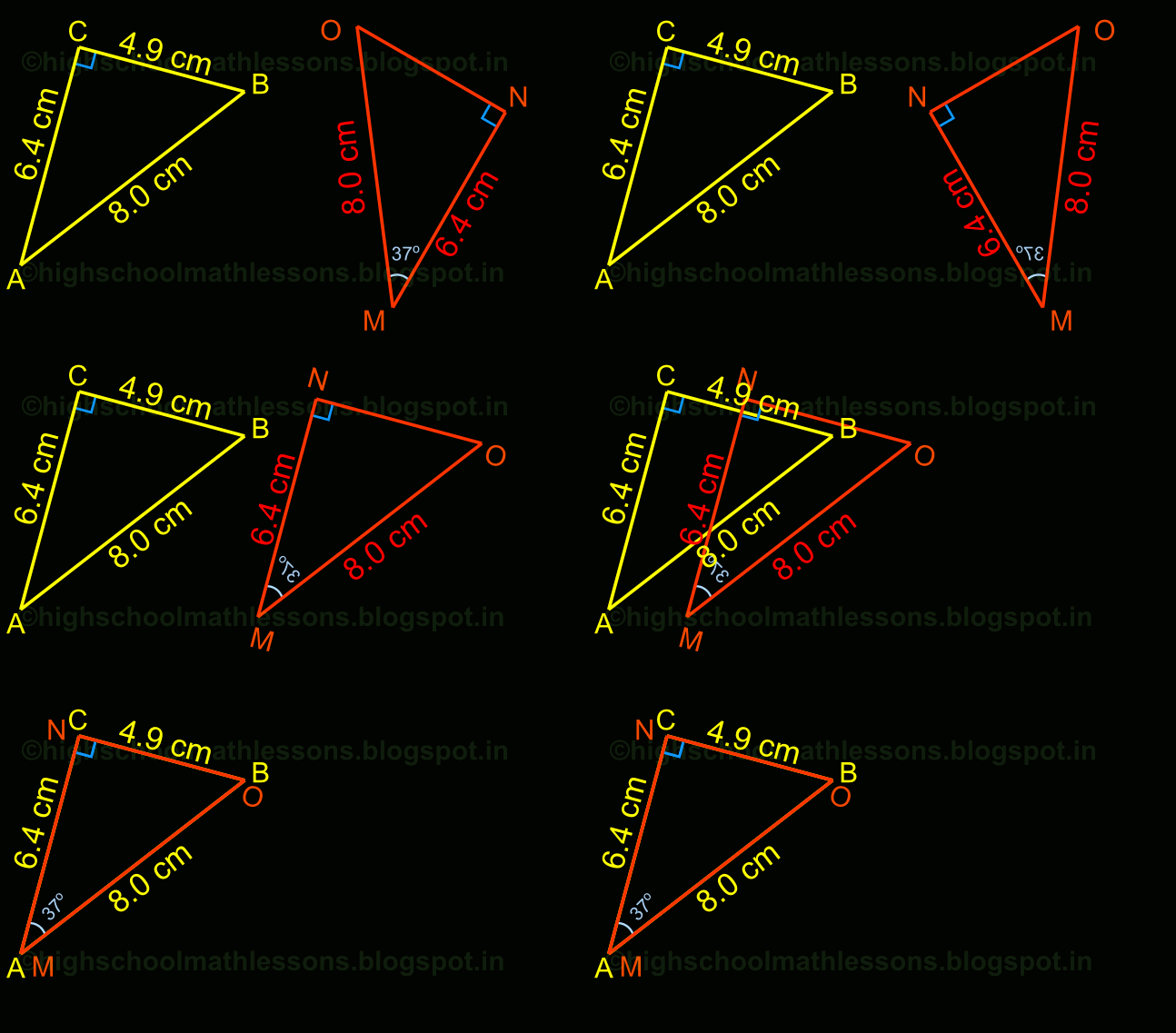
• Consider ΔABC and ΔMNO. In ΔABC, the 90o is at C. In ΔMNO, the 90o is at N. So we get CN
• We have considered the hypotenuse of 8 cm length, and a side of 6.4 cm length
• In ΔABC, these two sides intersect at A. In ΔMNO, these two sides intersect at M. So we get AM
• The only remaining corners are B and O. So we get BO
• So the correspondence is CN, AM, and BO. This can be written as ABC  MON
• So ΔABC and ΔMNO are congruent to one another under the correspondence: ABC  MON
• This is same as writing: ΔABC  ΔMON

So we have established the congruence, and put every relations between the two triangles in order. The following animation shows the superposition of ΔMON over ΔABC:
Fig.10.29
Based on the above discussion, we can write down the criterion:
■ RHS Congruence criterion:
If under a correspondence, the hypotenuse and one side of a right-angled triangle are respectively equal to the hypotenuse and one side of another right-angled triangle, then the triangles are congruent.

Solved example 10.13
Given below are some pairs of triangles. In each pair, examine if the triangles are congruent to one another. If they are congruent, write the correspondence.
(i) ΔABC: A = 90o AB = 3 cm, BC = 4.8 cm. ΔPQR∠P = 90o PR = 3 cm, RQ = 4.8 cm.
(ii) ΔXYZ∠X = 90o, XY = 4.7 cm, XZ = 2.8 cm, YZ = 5.5 cm. ΔMNO∠M = 90o, OM = 2.8 cm, ON = 5.0 cm
Solution:
(i) A rough sketch is shown in the fig.10.30(i) below:
Fig.10.30
• Both are right angled triangles
 From the rough sketch, it is clear that, both the triangles have the same 4.8 cm hypotenuse.
 A side of 3 cm length is present in both the triangles
 So the triangles are congruent to one another, based on the RHS criterion
• Now we have to write the correspondence:
• The 90o angle is at A and P. So AP
• In ΔABC, the 4.8 cm side and 3.0 cm side intersect at B
• In ΔPQR, the 4.8 cm side and 3.0 cm side intersect at R. So we get BR
• The only remaining corners are C and Q. So we get CQ
• So the correspondence is AP, BR and CQ. This is same as ABCPRQ
• So we can write: ΔABC and ΔPQR are congruent to one another under the correspondence: ABCPRQ
• This is same as ΔABC  ΔPRQ
(ii) A rough sketch is shown in the fig.10.30(ii)
• Both are right angled triangles
• From the rough sketch, it is clear that, ΔXYZ has a hypotenuse of 5.5 cm, while ΔMNO has a hypotenuse of 5.0 cm
• So the two triangles can never be congruent.
• A side of 2.8 cm length is present in both the triangles. But it does not alter the result.
• If the hypotenuse are different, the triangles can not be congruent
Solved example 10.14
Check whether ΔABC and ΔABD shown in fig.10.31 are congruent or not. Given that AD = BC. If congruent, write the correspondence, and all the corresponding parts.
Fig.10.31
Solution:
• The two triangles are ΔABC and ΔABD. Both are right angled.
• Hypotenuse of ΔABC is AB. Hypotenuse of ΔABD is also AB
 So both the triangles have the same Hypotenuse
 In ΔABC, there is a side BC, with a 'certain length'. In ΔABD, there is AD with the same length
 So ΔABC and ΔABD are congruent based on the RHS criterion
• Now we have to write the correspondence:
• In ΔABC, we considered the hypotenuse AB and a side BC. These two intersect at B
• In ΔABD, we considered the hypotenuse AB and a side AD. These two intersect at A. So we get AB
• In ΔABC, the 90o is at C. In ΔABD, the 90o is at D. So we get CD
• So the correspondence is: AB and CD. This is same as ABCBAD - - - (1)
• So we can write: ΔABC and ΔABD are congruent under the correspondence: ABCBAD
• This is same as: ΔABC ≅ ΔBAD
• Now we have to write the corresponding parts
■ We have already written the corresponding corners in (1). From that, we will get the corresponding sides also:
■ AB = BA, BC = AD and AC = BD
Solved example 10.15
Check whether ΔABC and ΔABD shown in fig.10.32 are congruent or not. Given that BD = BC. If congruent, write the correspondence, and all the corresponding parts.
Fig.10.32
Solution:
• The two triangles are ΔABC and ΔABD. Both are right angled.
• Hypotenuse of ΔABC is AB. Hypotenuse of ΔABD is also AB
 So both the triangles have the same Hypotenuse
 In ΔABC, there is a side BC, with a 'certain length'. In ΔABD, there is BD with the same length
 So ΔABC and ΔABD are congruent based on the RHS criterion
• Now we have to write the correspondence:
• In ΔABC, we considered the hypotenuse AB and a side BC. These two intersect at B
• In ΔABD, we considered the hypotenuse AB and a side BD. These two intersect at B. So we get BB
• In ΔABC, the 90o is at C. In ΔABD, the 90o is at D. So we get CD
• The only remaining corner is A in both the triangles. So we get AA
• So the correspondence is: A↔A, BB and CD. This is same as ABC↔ABD - - - (2)
• So we can write: ΔABC and ΔABD are congruent under the correspondence: ABC↔ABD
• This is same as: ΔABC ≅ ΔABD
• Now we have to write the corresponding parts
■ We have already written the corresponding corners in (2). From that, we will get the corresponding sides also:
■ AB = AB, BC = BD and AC = AD

So we have completed the discussion on congruence of Triangles. In the next chapter, we will learn the construction of Triangles.

PREVIOUS      CONTENTS       NEXT

                        Copyright©2016 High school Maths lessons. blogspot.in - All Rights Reserved

Thursday, May 19, 2016

Chapter 10.4 - ASA Criterion for the congruence of Triangles

In the previous section we have learned the SAS Criterion for the congruence of Triangles. In this section we will discuss about another criterion.

Fig.10.12(a) below, shows a triangle ABC. Fig.(b) shows five triangles: XYZ, WYZ, PQR, DEF, and MNO.
Fig.10.21
Our problem is this: Is there any triangle in fig.(b), which is congruent to ΔABC? If yes, which one?
Solution: Looking at figs.(a) & (b), we find that the measurements of the triangles are incomplete. None of the triangles have all lengths of all sides, or angles at all corners, marked on them. 
• If the triangles had the lengths of all the 3 sides, then we could straight away use the SSS criterion to check the congruence. 
• If two sides and their included angle is given, we could use the SAS criterion. 
But in this situation, these are not possible because the measurements are incomplete. We cannot find an SSS comparison or SAS comparison. In such situations, we must try to use other criteria.

We are going to use a rule known as the ASA criterion. As before, the 'A' stands for angle, and, the ‘S’ stands for ‘Side’. So this is the abbreviation for 'Angle Side Angle criterion'. Two angles and one side. 
■ This rule is based on the fact that, when two triangles are congruent, any two angles, and the side between those angles, in one triangle will be present in the other triangle. This rule will become clear when we apply it to our problem:
• In fig.(a), We have ΔABC with two angles and the included side: A = 65o,  C = 82o and the included side AC = 2.7 cm
• In fig.(b) we have one particular triangle, which is ΔDEF with the two angles and the included side: E = 65o,  D = 82o and the included side ED = 2.7 cm
• The two angles and the included side are the same. So ΔABC and ΔDEF are congruent.
■ We are able to establish congruence just by using two angles and the included side. All other sides and angles may or may not be given in the problem. But we do not need them to establish congruence. 

Some important points to note:
• 'ASA' denotes two angles and one side. This side should be the included side between the chosen angles. If we take any other side, the congruence will not work.
• In this problem, we chose the angles A and C, and the side AC between them. We used them for the comparison, and arrived at the conclusion that ΔABC and ΔDEF are in congruence.
• If ΔABC and ΔDEF are in congruence, there will surely be other two ASA combinations also. We will write all the three:
■ [A, C, and the included side AC] has a corresponding combination which we already found out: [∠E∠D, and the included side ED]
■ [∠BC, and the included side BC] will have a corresponding combination, which we are yet to find
■ [A, ∠B, and the included side AB] will have a corresponding combination, which we are yet to find

So there are two details that we are yet to find. Those two details are not necessary to establish a congruence. But establishing a congruence does not solve the problem completely. We have a little more work to do. We have to put the sides and corners of the two triangles in order. We do this by writing the correspondence. And, after writing the correspondence, we will be able to write those two details very easily. 

So let us try to write the correspondence:
The one detail which we already know, can be shown by a rough sketch as in the fig.10.22 below:
Fig.10.22


• From the fig.10.22, it is obvious that AE and CD. Because, A and E have the same measure, and similarly, C and D have the same measure
• The only remaining corner in the first triangle is B, and that in the second triangle is F. So we get BF
• So the correspondence is: A↔E,  B↔F, and  C↔D. This is same as ABC↔EFD
• Thus we can write: ΔABC and ΔDEF are congruent to one another under the correspondence ABC↔EFD
• This is same as writing: ΔABC  ΔEFD
Now, we use the rough sketch in fig.10.13 above to write the two missing details:
■ [∠BC, and the included side BC] in ΔABC has a corresponding combination in ΔDEF. What is it?
• We have  B↔F, and  C↔D. So BCFD
• Thus the corresponding combination is: [∠F∠D, and the included side FD]
■ [A, ∠B, and the included side AB] in ΔABC has a corresponding combination in ΔDEF. What is it?
• We have  A↔E, and  B↔F. So AB↔EF
• Thus the corresponding combination is: [∠E∠F, and the included side EF]

So we have established the congruence, and put every relations between the two triangles in order. The following animation shows the superposition of ΔDEF over ΔABC:
Fig.10.23
Based on the above discussion, we can write down the criterion:
■ SAS Congruence criterion:
If under a correspondence, 'two angles and the included side' of a triangle are equal to 'two corresponding angles and the included side' of another triangle, then the triangles are congruent.

Solved example 10.9
There are two triangles. ΔPQR and ΔXYZ. We are required to establish a congruence: ΔPQR  ΔYXZ. It is known that PQ = YX. What additional information is required to establish the congruence?
Solution:
• The required congruence is:  ΔPQR  ΔYXZ
• So PY, QX and RZ
• It is known that PQ = YX
• Let us draw a rough sketch as shown below:
Fig.10.24
• From the fig., it is clear that, if we are given an additional information that, P = Y, and Q = X, the two triangles will be congruent  (ASA congruence)
Solved example 10.10
In fig.10.25, UW = VX. Establish the congruence between ΔOUW and ΔOVX, and write the correspondence
Fig.10.25
Solution:
• In the two triangles, UW = VX. So we have one side equal.
• If we can prove that the 'corresponding angles at the ends of these sides' also equal, then the triangles will be congruent by the ASA rule. So let us try to prove it:
• We have U + O = 27 + 37 = 64o
 ∴ ∠W = 180 - 64 = 116o  ( sum of the interior angles of a triangle is 180o)
• UOW = VOX = 37o (∵ they are opposite angles )
• In ΔOVX, O + V = 37 + 27 = 64o 
 ∴ ∠X = 180 - 64 = 116o  ( sum of the interior angles of a triangle is 180o)
• Thus we get W = X. We already have U = V and lengths of sides UW = XV
• So  ΔOUW and ΔOXV are congruent according to the ASA congruence criterion
• Now we have to write the correspondence:
• We have W = X and U = 
• So WX and UV. The only remaining corner is O. So OO
• This can be written as OUWOVX
• So we can write: ΔOUW and ΔOXV are congruent under the correspondence OUWOVX
• This can also be written as ΔOUW  ΔOVX
Solved example 10.11
Given below are some pairs of triangles. In each pair, examine if the triangles are congruent to one another. If they are congruent, write the correspondence.
(i) ΔABC: A = 30o B = 45o, AB = 4 cm. ΔXYZ: Y = 30oZ = 45o, YZ = 4 cm
(ii) ΔPQR∠P = 40o ∠Q = 60o, PQ = 7 cm. ΔABC∠A = 40o∠B = 60o, AC = 7 cm
(iii) ΔXYZ∠X = 80o ∠Y = 50o, XY = 6 cm. ΔPQR∠P = 80o∠R = 50o, PQ = 6 cm
Solution:
(i) A rough sketch is shown in the fig.10.26(i)
Fig.10.26
• Side AB = YZ, A = Y   and   B = Z. So the triangles are congruent by ASA criterion
• Now we write the correspondence:
• A = Y = 30o. So AY. 
• B = Z = 45o. So BZ
• The remaining corners are C and X. So CX. 
• Thus we have AY, BZ, CX    ABCYZX
• So ΔABC and ΔXYZ are congruent under the correspondence ABCYZX
• This is same as ΔABC  ΔYZX
(ii) A rough sketch is shown in the fig.10.26(ii)
•  ∠P = ∠A   and   ∠Q = ∠B. But length of AB is not given.
• AC is given as 7 cm. If C = 60o, AC will correspond to PQ
• So we have to find C:
• C = 180 - (40 + 60) ( sum of the interior angles of a triangle is 180o)
• So C = 180 - 100 = 80o
• So C is not 60o, and thus, without the length of AB, we can not say if the two triangles are congruent or not
(iii) A rough sketch is shown in the fig.10.26(iii)
•  ∠X = ∠P   and   ∠Y = ∠R. But length of PR is not given.
• PQ is given as 7 cm. If Q = 50o, PQ will correspond to XY
• So we have to find ∠Q:
• Q = 180 - (80 + 50) ( sum of the interior angles of a triangle is 180o)
• So ∠Q = 180 - 130 = 50o
Q is indeed equal to 50. So we have an ASA congruence
• Now we write the correspondence:
• X = P = 80o. So X↔P
• ∠Z = Q = 50o. So Z↔Q
• The remaining corners are Y and R. So Y↔R
• Thus we have X↔P, Y↔R, Z↔Q    XYZ↔PRQ
• So ΔXYZ and ΔPQR are congruent under the correspondence XYZ↔PRQ
• This is same as ΔXYZ  ΔPRQ
Solved example 10.12
In the fig.10.27 below, the ray OS bisects POR. It also bisects PQR. Prove that OP = OR and PQ = RQ
Fig.10.27
Solution:  
• The ray OS bisects ROP. So we get ROQ = POQ
• The ray OS bisects PQR. So we get PQO = RQO
• OQ is common. So we have an ASA congruence
• The triangles ΔOQR and ΔOQP are congruent.
• Now we have to write the correspondence:
 For the ASA congruence, we took [ROQ, OQR, and their included side OQ] in ΔOQR
 We took [POQ, OQP and their included side OQ] in ΔOQP
• The above two are the corresponding combinations
• In those corresponding combinations, ROQ = POQ. So we get OO
• Also OQR = OQP. So we get QQ
• The only remaining corners are P and R So we get PR
• Thus we can write OPQORQ
• So the two triangles ΔOPQ and ΔOQR are congruent under the correspondence: OPQORQ
• This is same as ΔOPQ  ΔORQ
• Now we have to prove that OP = OR
• We have already proved that OO and P
• So OP and OR are corresponding sides. Corresponding sides of congruent triangles will be equal in length. Thus OP = OR
• Next we have to prove that PQ = RQ
• We have already proved that PR and QQ
So PQ and RQ are corresponding sides. Corresponding sides of congruent triangles will be equal in length. Thus PQ = RQ

So we have completed the discussion on ASA criterion. In the next section we will discuss about one more criterion.

PREVIOUS      CONTENTS       NEXT

                        Copyright©2016 High school Maths lessons. blogspot.in - All Rights Reserved